Memory Superstar Eats Like a Bird

How has your memory been lately? You’ve been a little absent-minded, haven’t you? (Your keys are on the dining room table, right where you left them.)

If you don’t have a border collie to help you remember things, you may want to see if there are any Clark’s Nutcrackers in the neighborhood.

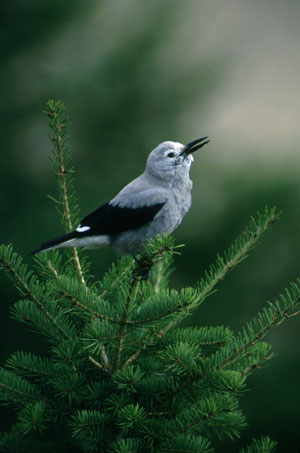
Clark's Nutcracker thinking about eating 30,000 pine nuts (photo: US Fish & Wildlife Service)

Clark’s Nutcrackers are medium-sized birds in the corvid family (the same family as jays, crows and ravens) that live in the Western United States and that rely on their memory to relocate stored food during the long winter months.  Every year, they can harvest more than 30,000 seeds from pine cones, which they then hide in thousands of separate places within a 15 mile or so radius.

Their memories for these locations are pretty incredible.  As one researcher, Brett Gibson, described it in a ScienceDaily1 article:

Nutcrackers are almost exclusively dependent upon cache recovery for their survival so if they don’t remember where they’ve made those caches, then they are in trouble. During winter, their cache locations are covered with snow so many of the small local features in the landscape during fall are no longer available to them. What’s clear is that they are using spatial memory to recover these caches. They are remembering these caches based on landmarks and other features of the terrain.

Another biologist, Russell Balda, who has studied Nutcrackers for a number of decades, is even more effusive in National Wildlife2 magazine:

How these birds find their caches looked like an incredible feat when we began studying them. We soon found out that the Clark’s nutcracker is the spatial memory superstar of the avian world, and possibly of the vertebrate world.

These two articles note that there is still some uncertainty about exactly how the Nutcracker is able to have such an astonishingly good memory. Regardless of how they do it, though, I think we all can be impressed by – and a little jealous of – these birds and their brains.

_____

1ScienceDaily, “Researcher Uncovering Mysteries Of Memory By Studying Clever Bird,” October 12, 2006.

2National Wildlife, “THE BIRD THAT NEVER FORGETS – The unassuming Clark’s nutcracker has one of the most remarkable memories in the animal kingdom,” October 1, 2000.

Fishing Buddies

We are all familiar with talented sports teams that underachieve because, despite the individual abilities of their players, they’ve been unable to “pull together” and coordinate their efforts effectively. Because teamwork requires cooperation, communication, and complex social interaction, we typically bring in outside coaches to create an environment that allows teamwork to develop, and we reserve our highest praise (and compensation) for those rare players who have the gift of making others better while being successful themselves (just ask Magic Johnson and Larry Bird).

With that in mind, you may be surprised to learn that a couple of the world’s most accomplished team players can be found not on the playing field or in the arena, but under the sea, and that they are members of different species of fish.

Grouper (from Wikipedia; photo credit: Jon Hanson)

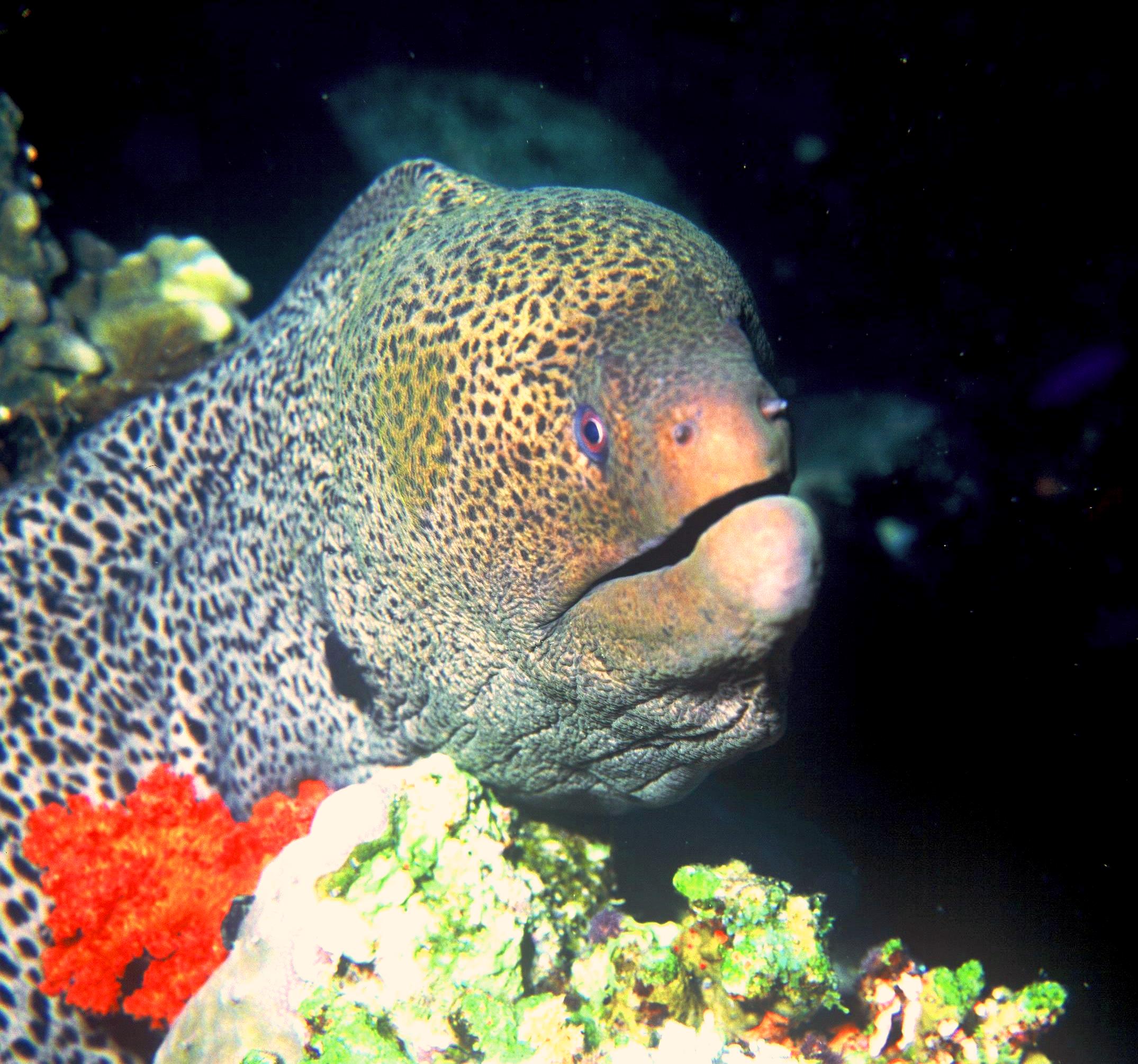
In recent research published in PLoS Biology1, scientists reported on a highly coordinated and communicative hunting partnership between the grouper and the giant moray eel, which they observed in the coral reefs of the Red Sea. Together, the two fish make an extremely complementary and formidable hunting team.

Groupers, large predatory reef fish, are daytime hunters, while morays usually hunt at nght and rest in crevices during the day. Groupers typically hunt in open water near reefs and have trouble catching fish that hide in the holes and crevices that they find in the coral. Moray eels, on the other hand, sneak around reef crevices and attempt corner prey in holes, but have trouble catching fish in open water.

Giant Moray Eel (from Wikipedia; photo credit: Albert Kok)

As the research report observed: “The hunting strategies of the two predators are therefore complementary, and a coordinated hunt between individuals of the two species confronts prey with a multipredator attack that is difficult to avoid; prey are not safe in open water because of the grouper hunting strategy but cannot hide in crevices because of the moray’s mode of attack.”

The researchers found that hungry groupers would actively seek out their moray eel fishing partners in their crevices and shake their heads rapidly right in the eels’ faces to let them know that it was time to go for a hunt. Here’s a video of a grouper letting an eel know that it is time to eat.

The morays would then leave their hiding holes and swim off in search of food with the groupers. Here’s a video of the hunting twosome happily swimming off together for dinner.

Moreover, the pair would cooperate as they hunted. In some cases, for instance, a grouper would remain directly above a crevice where prey was hiding, perform “headstands” and shake its head to guide the moray eel to the hidden prey’s location.

The researchers noted that, when the two fish worked together as a team, the groupers caught five times as many fish as they did separately, and the moray eels caught almost twice as many fish as the groupers. (Because the morays normally hunt at night, the researchers didn’t observe them catching any fish separately, so they were not able to draw any conclusions regarding how their partnership with the groupers changed their hunting efficiency.)

This type of inter-species coordinated hunting with differentiated roles is extremely rare and had never been seen before in fish. If you think about it, this is pretty complex and advanced behavior, as the individuals must perform specific actions and play specific roles, knowing that their counterparts are doing the same. The groupers, with their intentional signaling to call their moray partners to the hunt and to direct them to prey, demonstrate particularly sophisticated, cognitively advanced behavior.

So, forget about your local sports franchise; if you want to see some especially impressive teamwork, you should put on your wetsuit and let some reef fish show you how it’s done.

_____

1Bshary R, Hohner A, Ait-el-Djoudi K, Fricke H. Interspecific Communicative and Coordinated Hunting between Groupers and Giant Moray Eels in the Red Sea. PLoS Biol 2006 4(12): e431. doi:10.1371/journal.pbio.0040431.

My Border Collie Is Smarter Than Your Honor Student

Or so the bumper sticker says.

On this Fourth of July, it seems appropriate to salute man’s best friend in a brief holiday post. Meet Chaser, a true canine linguistic champion.

Chaser understands more than 1,000 words, along with simple sentences. Her vocabulary includes the names of 1,022 objects, including 800 stuffed animals, 116 balls and 26 “Frisbees,” any of which she can fetch on command.

Chaser, resting after studying for the bar exam (photo credit: ABCNEWS.com)

In addition, if a new toy is placed among her playthings, she is able to retrieve it when given its unfamiliar name, inferring its identity by a process of exclusion. She also has been studying her verbs, demonstrating that she knows how to “find,” “nose” and “paw” each of her toys. I assume that next she will be working on her gerunds and finishing her mastery of the subjunctive mood.

Happy Fourth, Chaser!

You can read more about Chaser and see her in action in this ABC News1 story.

_____

1ABC News, “World’s Smartest Dog? Meet a Border Collie Whose Memory Astounds,” February 9, 2011.

A Reflection of Intelligence?

What is it that makes us most “human,” distinguishing us from other animals?

One common response is that we have a sense of self, an ability to recognize ourselves as being separate and distinct from other individuals. Thus, when I look in the mirror, I know that I am looking at myself and not a dashingly handsome stranger. You know this as well; when you gaze in the mirror, you realize that the incredibly attractive person peering back is you!

How about other animals? They don’t “get” mirrors, do they? When they look at mirrors, don’t they either stare blankly or, at best, act as if they have seen another animal? (Hey, what’s that other beast doing on my turf? I wonder if it’s friendly….) Right?

Wrong.

Increasingly, we are finding that the answer is that other animals know exactly who is staring back at them.

First, we found out that certain great apes, like chimpanzees, can recognize themselves in mirrors. Ok, we all know that primates are smart; I’ll buy that. Then, it was bottlenose dolphins. All right, Flipper was pretty darned smart, plus dolphins have those big melon-shaped heads. I suppose that makes sense. Next, Asian elephants. Really? That’s sounds a bit odd. They do have those big eyes, but still…. I guess if you say so. Most recently, birds. Hey, now, wait a minute!

That’s right, magpies are the newest – and only non-mammal – member of the mirror self-recognition club.

Magpies with colored stickers recognize themselves in the mirror (photo credit: Helmut Prior, Goethe University)

As published in PLoS Biology1, researcher Helmut Prior and his colleagues affixed a red, yellow or black mark to feathers on the throats of five magpies (the black marks were basically a “control”: since they were the same color as the surrounding feathers they were essentially invisible to the magpies, thereby allowing the researchers to see whether any magpie behavior during the tests was the result of feeling, rather than seeing, the marks). The colored spots were positioned so that they could not be seen by the magpies unless they were looking in a mirror. When the researchers added a mirror to the cage, certain of the magpies noticed the colored spots in the mirrors and displayed “mark-directed” behavior, swiping at the marks with their beaks or scratching at them with their feet, and then checking in the mirror to determine whether they had successfully removed them. The magpies did not attempt to remove the black spots, which they couldn’t see in the mirror. Here’s a YouTube video of one of the magpies during the testing:

Also, you can read nice summaries of the research and mirror self-recognition testing in ScienceNOW2 and NewScientist3 online magazines.

This research is particularly notable given the differences between the neural anatomy of birds and mammals. Science Daily4 describes the significance:

These findings not only indicate that non-mammalian species can engage in self-recognition behaviour, but they also show that self-recognition can occur in species without a neocortex. This area is thought to be crucial to self-recognition in mammals, and its absence in this case suggests that higher cognitive skills can develop independently along separate evolutionary lines.

Mammals and birds have developed vastly different brain structures, and future studies will be able to further examine how these structures converge to produce similar cognitive abilities.

So, the magpie, lacking a neorcortex area in its brain and with an evolutionary history that diverged from ours 300 million years ago, shares our ability to look into a mirror and see itself.

The point here is not that birds can think like humans – they undoubtedly think like birds. Rather, the lesson is that we need to be very careful in labeling ourselves as special, as having exclusive abilities and intellectual talents. The more we study other animals, the more have found – and the more we will continue to find – how much we have in common, how much we share. Increasingly, I think we will find that our claims regarding uniquely human abilities are just not true, that they are simply smoke and mirrors.

_____

1Prior, H., Schwarz, A., & Güntürkün, O. (2008). Mirror-Induced Behavior in the Magpie (Pica pica): Evidence of Self-Recognition PLoS Biology, 6 (8) DOI: 10.1371/journal.pbio.0060202.

2ScienceNOW, “The Magpie in the Mirror,” August 19, 2008.

3NewScientist, “Mirror test shows magpies aren’t so bird-brained,” August 19, 2008.

4ScienceDaily, “Mirror Self-Recognition In Magpie Birds,” August 19, 2008.

The Awesome Octopus

I wanted to devote today’s post to a wonderful presentation on cephalopods that Maggie Koerth-Baker, the Science Editor at BoingBoing.net, gave last January at the University of New Mexico’s annual conference on Integrating Nanotechnology with Cell Biology and Neuroscience.

There is also a 10-minute edited version of the presentation, which you can find here, but I highly recommend spending half an hour to take in the full video (below), since many of the really fascinating stories have been edited out of the shorter version.

There are parts of Koerth-Baker’s presentation that I just love, particularly how she addresses the question of how we define intelligence.  As she puts it (and this part isn’t contained in the edited version):

Intelligence is a loaded word.  What does intelligence mean to you? IQ tests, grade point average, the ability to communicate via spoken language?

One thing is certain: “intelligence” makes us think of human stuff, people things. And that’s not fair.

An octopus doesn’t need to be able to pass a written exam. It never has. To judge animals against human ideas of what intelligence means in humans is to miss the point of evolution. Our brains are not this private club that the rest of animal-kind is trying to be cool enough to get into. Every species has adapted over millions of years to have a brain that allows it to be smart for its particular niche.

Octopus brains can get octopus jobs done, and they don’t have to worry about whether they can tackle human issues. Your octopus will not do your homework, but that doesn’t mean it’s stupid.

Later, she adds:

It is absolutely true that there is something very different, and very exciting, going on in the cephalopod brain, especially when you consider its nearest relatives. Cephalopods are closely related to mollusks, and their family reunion would feature such dignitaries as snails and oysters.

A layman might go ahead and call it “intelligence.” I’m just going to call it “being awesome.”

These are not big brained creatures. They can’t navigate a maze like a cephalopod can. They can’t react quickly and change their behavior to reflect minute by minute changes in their environment. And, with a couple of notable exceptions, they don’t seem to be able to remember information and use it in the future.

In the nature and in the lab, invertebrate cephalopods act more like vertebrates. Researchers describe this special class of conduct as “behavior plasticity” or “behavioral flexibility.” A layman might go ahead and call it “intelligence.” I’m just going to call it “being awesome.”

The full presentation goes on to illustrate various “awesome” abilities of the cephalopods, including decision-making, arguable tool use, and communication with other cephalopods. Koerth-Baker also provides a vivid example of how an octopus will engage in highly sophisticated mental processes in executing tactics to escape predators. When faced by a researcher perceived to be attacking:

an octopus would swim backwards away from [the researcher] toward handy places where it could hide. When it got to one of these spots, the octopus would squirt out a jet of ink in one direction, and dive away in the opposite direction, immediately changing its camouflage to match its new hidey-hole. Basically, it was giving him the old dodge and feint routine.

Now, think about everything an octopus had to do to process that. While swimming for its life, it had to know where [the researcher] was and where the next hidey holes were. It had to think about the timing to trick [the researcher] with the ink squirt. And it had to know what color and texture to turn its skin as it dove away. All of that pretty much at the same time. That’s broad awareness and complex decision-making, done at high speeds by a creature with a mollusk brain.

Verdict: awesome.

Indeed.

It really is thought provoking to consider the concept of intelligence, particularly in animals that are so different than we are. The latter part of the video provides an overview of the octopus brain and neural anatomy – if you think you know how a brain generally looks and functions (or should look and function), you will find this segment to be eye opening.

So, how intelligent are the cephalopods? They can’t read or write, they can’t speak, they aren’t particularly social. Their brains, while larger than any other invertebrate’s (and comparable in size to the brains of dogs and cats), are nowhere near the size of human brains, and cephalopods don’t exhibit many of the higher cognitive functions that we test when we measure human intelligence. Their SAT scores would undoubtedly be unimpressive.

On the other hand, how would we humans do on an octopus intelligence test, one that required us to consciously change our shapes, colors, textures and brightness in order to adapt to threats and changing environmental conditions? Cephalopods have incredible mental abilities that we are totally lacking – what does this say about whether those mental abilities are, or are not, evidence of intelligence?

These are hard questions, but one point should be pretty clear. Octopuses are awesome.

Thank you, Maggie.

A Smart Fish in a Dangerous Pond

Mistakes are the portals of discovery.
James Joyce

Do not fear mistakes. You will know failure. Continue to reach out.
Benjamin Franklin

Nice quotes, but I think I’ll just avoid making mistakes, thank you very much.
Stickleback Fish

When you or I make a mistake, we can seek comfort in witty sayings, self-help programs and expensive therapy sessions. When a nine-spined stickleback fish makes a mistake, it often ends up in the belly of another marine animal.

Nine-Spined Stickleback (BBC News)

Perhaps motivated by this rather unpleasant truth, sticklebacks – a small fish commonly found in North America, Europe and Asia – have developed some unusually sophisticated social learning capabilities. In particular, sticklebacks are able to compare the feeding behavior of other sticklebacks with their own experience and choose which fish to copy in order to find more food. This capability, sometimes referred to as a “hill climbing” strategy, has not been observed in any animals other than sticklebacks and humans … at least those humans who aren’t too busy making mistakes in order to enjoy character-building learning opportunities. More importantly (to the sticklebacks), this voyeuristic approach to feeding enables them to learn where to feed while relaxing in safe places rather than running a gauntlet of predators to search for feeding sites in the open.

In a study published in Behavioral Ecology1, English researchers placed 270 sticklebacks in a tank with two feeders, one of which – the “rich feeder” – supplied a lot more food than the other. The fish that learned to prefer the rich feeder were then allowed to watch other sticklebacks feeding in the same  tank but, this time, the rich feeder no longer provided more food (in some cases, it provided less food, in others it provided about the same amount of food). When the observing group was given another opportunity to feed, about 75% were “clever” enough to know from watching the other fish that they should avoid the formerly rich feeder if it was now giving out less food, choosing the new improved feeder instead. However, in situations where the change in feeders resulted in each providing roughly the same amount of food, the observers did not copy the other fish and stuck with their initial choice.

As reported in ScienceDaily2, the BBC News3, and the Guardian4, one of the authors, professor Kevin Laland from the School of Biology at St Andrews University, saluted the sticklebacks for their learning prowess: “Nine-spined sticklebacks may be the geniuses of the fish world. It’s remarkable that a form of learning found to be optimal in humans is exactly what these fish do.” Another researcher, Jeremy Kendal from Durham University’s anthropology department added: “Hill-climbing strategies are widely seen in human society whereby advances in technology are down to people choosing the best technique through social learning and improving on it, resulting in cumulative culture. But our results suggest brain size isn’t everything when it comes to the capacity for social learning.”

So, in a fish eat fish world where mistakes can be costly, we would be well advised to balance our trial by error tendencies against the wisdom of a species that has learned how to succeed without putting itself into jeopardy.

_____

1Jeremy R. Kendal, Luke Rendell, Thomas W. Pike, and Kevin N. Laland. Nine-spined sticklebacks deploy a hill-climbing social learning strategy. Behavioral Ecology, 2009; 20 (2): 238.

2ScienceDaily, “Common Fish Species Has ‘Human’ Ability To Learn,” June 17, 2009.

3BBC News, “‘Genius’ claim for sticklebacks,” June 17, 2009.

4The Guardian, “Sticklebacks show human-like intelligence when searching for food,” June 16, 2009.

Memory: Chimp is Champ!

It didn’t sound like a fair contest: the memory champion of the UK against a lowly chimpanzee. In one corner, Ben Pridmore, a man capable of memorizing all of the cards in a shuffled deck in less than half a minute; in the other corner, Ayumu, a seven year old hairy primate wearing no clothes.

No, it wasn’t fair at all.

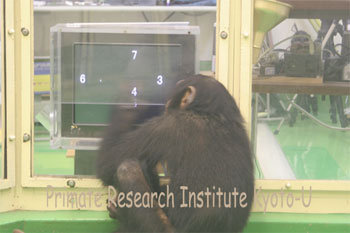
As reported in the UK Daily Mail1, both chimp and man watched a computer screen on which five numbers flashed up at various positions before being obscured by white squares, and then had to touch the squares in order of the numbers they concealed, from lowest to highest.

Ayumu hard at work (photo credit: Primate Research Institute Kyoto University)

By the time the competition heated up and the numbers were shown for a mere fifth of a second, the results weren’t even close: while the winner was able to order the numbers correctly almost 90% of the time, the loser couldn’t even manage 33%.

Fortunately, NaturalNews.com2 notes that the loser was gracious in defeat: “It is extremely impressive for anybody,” Pridmore said when asked about Ayumu’s performance. “He is doing something which I think is a really great performance even by human standards, so I’m sort of forgetting he is not a human being. When I bring that into the equation, it makes it overwhelmingly impressive.”

(If you wish to try to avenge Mr. Pridmore’s loss, the good news is that there’s a website3 where you can watch a video of Ayumu in action and then take the memory test yourself. Good luck, our species is counting on you.)

You may be thinking that this is a meaningless fluke, a highly specific area where a chimpanzee just happens to excel, a parlor trick that is not at all indicative of true intelligence. Well, maybe so, but don’t we as humans like to point to these sorts of unique abilities as precisely what set us apart from the rest of the animal kingdom? Are we tilting the playing field by giving inordinate weight to the mental gifts that we enjoy, downplaying others and defining intelligence to suit ourselves and our abilities? Perhaps we should ask Ayumu what he thinks…

_____

1The Mail Online, “I’m the chimpion! Ape trounces the best of the human world in memory competition,” January 26, 2008.

2NaturalNews.com, “Chimpanzee Beats Human Memory Genius in Memorization Competition,” August 3, 2008.

3lumosity games website, visited June 28, 2011.

Improbable Pigeons

I have bad news for you – a pigeon can probably outperform you in the area of probability and statistics.  Yes, that’s right, a pigeon.

The Problem:

Consider the classic “Monty Hall” problem, named after the original host of the Let’s Make a Deal game show:

Suppose you’re on a game show and are given the choice of three doors. Behind one door is a car; behind the others, goats. The car and the goats were placed randomly behind the doors before the show. Before opening the door you’ve picked, the host, who knows what’s behind the doors, must open one of the remaining doors and make you an offer. Accordingly, he opens a door, reveals a goat, and asks you whether you want to stay with your first choice or switch to the last remaining door.

Assuming you want a car and not a playful goat, should you stick with your first choice or go for the remaining door?

The Answer:

This may sound counterintuitive (unless you’re a pigeon), but you actually have twice the chance of winning the car if you change your selection and pick the remaining door.  Why is this?  Well, the relevant Wikipedia1 entry includes the following table, which shows the three possible arrangements of one car and two goats behind three doors and the result of switching or staying after initially picking Door 1 in each case:

Door 1 Door 2 Door 3 Result if switching Result if staying
Car Goat Goat Goat Car
Goat Car Goat Car Goat
Goat Goat Car Car Goat

As shown above, a player who stays with the initial Door 1 choice wins in only one out of three of these equally likely possibilities, while a player who switches wins in two out of three.

How Do People Perform?

In a word, poorly.

Most people will stay with their initial choice or, at best, express no preference either way. In one high profile case, Marilyn Vos Savant (she of the world’s highest IQ) published the answer to the puzzle in Parade magazine and approximately 10,000 readers, including nearly 1,000 with Ph.D.’s, wrote in to vehemently claim she was wrong. The New York Times2 published a fuller explanation of the Monty Hall problem as well as an entertaining account of the Vos Savant incident and how a large number of mathematicians and other well-educated people refused to accept the correct answer, even after being shown multiple proofs of its accuracy.

How Do Pigeons Perform?

Much better!

As published in the Journal of Comparative Psychology3, researchers Walter Herbranson and Julia Schroeder designed a series of experiments in which six pigeons were tested to see how well they would do at solving the Monty Hall problem, and how their performance would compare to that of university undergraduate students. Discover Magazine’s Not Exactly Rocket Science4 blog describes the experiments and the results:

Each pigeon was faced with three lit keys, one of which could be pecked for food. At the first peck, all three keys switched off and after a second, two came back on including the bird’s first choice. The computer, playing the part of Monty Hall, had selected one of the unpecked keys to deactivate. If the pigeon pecked the right key of the remaining two, it earned some grain. On the first day of testing, the pigeons switched on just a third of the trials. But after a month, all six birds switched almost every time, earning virtually the maximum grainy reward.

Every tasty reward would reinforce the pigeon’s behaviour, so if it got a meal twice as often when it switched, you’d expect it to soon learn to switch. Hebranson and Schroder demonstrated this with a cunning variant of the Monty Hall Dilemma, where the best strategy would be to stick every time. With these altered probabilities, the pigeons eventually learned the topsy-turvy tactic.

It may seem obvious that one should choose the strategy that would yield the most frequent rewards and even the dimmest pigeon should pick up the right tactic after a month of training. But try telling that to students. Hebranson and Schroder presented 13 students with a similar set-up to the pigeons. There were limited instructions and no framing storyline – just three lit keys and a goal to earn as many points as possible. They had to work out what was going on through trial and error and they had 200 goes at guessing the right key over the course of a month.

At first, they were equally likely to switch or stay. By the final trial, they were still only switching on two thirds of the trials. They had edged towards the right strategy but they were a long way from the ideal approach of the pigeons. And by the end of the study, they were showing no signs of further improvement.

In their article, Herbranson and Schroeder summarized the results even more succinctly: “The surprising implication is that pigeons seem to solve the puzzle, arriving at the optimal solution while most humans do not.”

Conclusion

While we will accept the view of the researchers that this doesn’t prove that pigeons are smarter than humans, we still think that, if you ever have a chance to appear on Let’s Make a Deal, you should consider bringing a real bird rather than a friend dressed up in a giant bird costume.

_____

1Wikipedia, Monty Hall Problem, visited on June 27, 2011.

2The New York Times, “Behind Monty Hall’s Doors: Puzzle, Debate and Answer?,” July 21, 1991.

3Herbranson WT, Schroeder J. Are birds smarter than mathematicians? Pigeons (Columba livia) perform optimally on a version of the Monty Hall Dilemma. J Comp Psychol. 2010 Feb;124(1):1-13.

4Discover Magazine, Not Exactly Rocket Science Blog, “Pigeons outperform humans at the Monty Hall Dilemma,” April 2, 2010.
Udderly Intelligent

While you might be willing to acknowledge that a cow can be out standing in its field, I’m willing to bet that you don’t typically think of Bessie as leading a rich intellectual and emotional life.  You might want to think again.

According to The Sunday Times1, “cows have a secret mental life in which they bear grudges, nurture friendships and become excited over intellectual challenges.” Moreover, cows don’t have a monopoly on farm animal intelligence, as the article reports similar findings for sheep, pigs, goats, chickens and other livestock.

Notable feats of barnyard intellectual prowess include:

  • Cows form friendship groups and spend most of their most of their timing licking, grooming and generally hanging out with a few other like-minded bovines.  They can also form dislikes and hold grudges “for months or years.” (Note to self: don’t get on the wrong side of a cow.)
  • Cows have become so excited in solving intellectual challenges such as figuring out how to open a door to get some food that their “brainwaves showed their excitement; their heartbeat went up and some even jumped into the air.” (Ok, that alone made this post worthwhile – I would pay to see a cow jump into the air as it solved a puzzle!)
  • Sheep can recognize up to 50 other sheep simply by looking at their profiles, and can remember the other sheep even after a year apart.  (Admit it, you can’t do that.)
  • Sheep can form strong affections for particular humans, become depressed when separated from their human friends, and greet them enthusiastically … even after three years.

So, a little additional respect for livestock is definitely in order.  While it may suit our purposes to think of farm animals as dumb, unfeeling beasts who exist only to serve us, this simply is not the case.  They are complex emotional beings that lead active intellectual lives filled with strong memories, friendships, dislikes, fears and great achievements.  Next time a cow turns its large head towards you and looks at you with those big brown eyes, remember that it just may leap with excitement if you tell it that it’s your friend.

_____

1The Sunday Times (UK), “The secret life of moody cows,” February 27, 2005.

Bees on Prozac?

News flash: this month Current Biology1 reported that that stressed bees have lower levels of neurotransmitters such as dopamine and serotonin and exhibit pessimism, a cognitive trait supposedly limited to “higher” animals.

Ok, this is waaay cool! Who knew that bees could be pessimists or even that they have “human” neurotransmitters like dopamine and serotonin coursing through their little systems?

ScienceDaily2 provided a layperson’s description of the research, reporting:

To find out how bees view the world, the researchers set them up to make a decision about whether an unfamiliar scent portended good or bad things. First, the bees were trained to connect one odor with a sweet reward and another with the bitter taste of quinine. The bees learned the difference between the odors and became more likely to extend their mouthparts to the odor predicting sugar than the one predicting quinine.

Next, the researchers divided the bees into two groups. One group was shaken violently for one minute to simulate an assault on the hive by a predator such as a honey badger. The other group was left undisturbed. Those bees were then presented with the familiar odors and some new ones created from mixes of the two.

Agitated bees were less likely than the controls to extend their mouthparts to the odor predicting quinine and similar novel odors, the researchers found. In other words, the agitated bees behaved as if they had an increased expectation of a bitter taste, the researchers said, demonstrating a type of pessimistic judgment of the world known as a “cognitive bias.”

Now, I don’t approve of shaking bees (violently or otherwise), even in the interest of scientific advancement. How would the researchers feel if giant swarms of bees swooped down on them and their families to see whether being blanketed by carpets of buzzing insects triggered negative emotional responses in humans?

Nevertheless, this study is an amazing demonstration of the deep commonality we share with our animal brethren (and sistren). The notion that humankind and beekind share the same neurotransmitters and similar stress reactions is somehow strangely comforting – c’mon, insects, we’re all in this thing together – we can do it! It’s almost enough to make you want to go out and hug a bee.

_____

1Bateson M, Desire S, Gartside SE, Wright GA. Agitated honeybees exhibit pessimistic cognitive biases. Curr Biol. 2011 Jun 21;21(12):1070-3.

2ScienceDaily, “For Stressed Bees, the Glass Is Half Empty,” June 3, 2011.