Perchance to Dream…

Do you ever wake up and feel like you’ve spent the whole night replaying a tape of the stresses of the day before? Well, at least you didn’t spend you didn’t spend that day running through mazes. Oh, you did? In that case, you might want to grab a chunk of cheese and sit down for some comfort eating with a friendly rat who can commiserate with you.

Matthew Wilson, an MIT professor of neuroscience, has been studying rats as they work and sleep for years, and has found out that they, too, replay their daily activities as they sleep.

Rat dreaming of running in circles... (MIT image)

In groundbreaking research published in 2001 in the journal Neuron1, Wilson and his colleague Kenway Louie were given an unprecedented glimpse into the dreams of rats by studying rats’ brain activity while they ran through mazes and then later on while they slept. (To clarify, the rats – not the researchers – were the ones who ran through the mazes. Sorry to disappoint you.)

To investigate what happens in the brain during rapid eye movement (REM) sleep, the type of sleep associated with dreaming, the researchers recorded the activity of neurons in the hippocampus (the area of the brain known to be critical to the formation and encoding memories) of four rats, both while the rats ran around circular mazes and then afterwards during REM sleep.

What they found out was striking.

As the rats ran through the mazes, the neurons fired in distinctive patterns that were dependent on where the rats were within the mazes. Then, when the researchers took comparable measurements of the rats’ brain activity later on during the rats’ REM sleep after a hard day of maze running, they found that the rats played back exactly the same neuron activity patterns as had occurred when they originally performed their tasks. More specifically, in 20 of the 45 REM sleep sessions that the researchers measured, they could detect prolonged periods (tens of seconds to several minutes in length) during which the same spatially-correlated hippocampal neurons fired in the same order, with the REM patterns essentially repeating the daytime patterns at approximately the same speed.

During REM sleep, we could literally see these rat brains relive minutes of their previous experience. It was like they were watching a movie of what they had just done.

In his terrific blog The Frontal Cortex2, Jonah Lehrer noted that Wilson was astonished by these results, quoting him as saying, “During REM sleep, we could literally see these rat brains relive minutes of their previous experience. It was like they were watching a movie of what they had just done.”

Wow!

More recently, Wilson and Daoyun Ji, a postdoctoral associate, extended these findings in research published in Nature NeuroScience3. In this newer study, the researchers focused on brain activity during slow-wave sleep (SWS), often referred to as deep sleep, a stage of sleep not characterized by dreaming but thought to be important to long-term memory formation. The researchers wanted to learn more about how the brain consolidates long-term memories during SWS, and whether it replays visual images from daytime experiences as part of the process. To test these matters, the researchers focused on the interaction between two separate areas of the brain: the hippocampus and the visual cortex, which is responsible for processing visual information.

As before, the researchers measured brain activity in four (presumably different!) rats as the rats ran in alternating directions through figure-eight shaped mazes, and then repeated the same measurements while the rats slept both before and after their maze-running sessions. This time, though, the researchers measured activity in both the visual cortex and the hippocampus.

Once again, the findings are notable.

As the rats ran through the mazes, neurons in both brain areas, the visual cortex and the hippocampus, acted similarly, firing in distinctive patterns that were dependent on where the rats were within the mazes. During subsequent SWS periods, the rats replayed these same firing patterns and sequences in both brain areas, much as they had done in the earlier experiment on hippocampus activity during REM sleep. Moreover, at all times, during maze-running activity and later on as the rats replayed their memories during periods of SWS, the brain activity in the visual cortex and the hippocampus were highly correlated.

By linking the visual cortex to this coordinated memory replay process, the researchers were thus able to show that not only were the rats replaying their daytime memories during sleep, but that they were reliving the same sensory experiences, the exact visual images that they had seen during their maze running!

Do these studies provide insight into the neurobiology of sleep, dreams and memory in humans and other animals? All mammals have similar brain structures that seem to operate similarly, and the research was designed to help us gain a better understanding of our own memory formation behavior, but it never hurts to ask these sorts of questions.

Assuming that these findings do have relevance for other species, then it may well be that when your Golden Retriever paddles his feet, rolls his eyes and twitches during sleep, he is indeed reliving that epic battle he recently had with an evil, slobber-covered tennis ball.

_____

1Louie, K., & Wilson, M. (2001). Temporally Structured Replay of Awake Hippocampal Ensemble Activity during Rapid Eye Movement Sleep Neuron, 29 (1), 145-156 DOI: 10.1016/S0896-6273(01)00186-6.

2The Frontal Cortex, “The Neuroscience of Dreaming,” December 19, 2006.

3Ji D, & Wilson MA (2007). Coordinated memory replay in the visual cortex and hippocampus during sleep. Nature neuroscience, 10 (1), 100-7 PMID: 17173043.
Chimps Don’t Ape Humans – Develop Tools Independently

The more we learn about the capabilities of animals, the less it seems we can claim as uniquely our own. Now it appears that we may even have to share our treasured Flintstones cartoons, as we have learned that we aren’t the only species to have enjoyed an ancient Stone Age history.

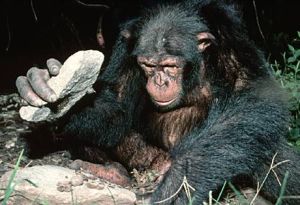
Chimp eating nuts and thinking about upcoming Chimpanzee Iron Age

A few years ago, archeologists led by Julio Mercader of the University of Calgary discovered that chimpanzees in West Africa were using stone tools to crack nuts thousands of years ago, before humans had begun engaging in agriculture in the area. The research team, exploring sites located in the Ivory Coast’s Taï National Park, found stone “hammers” that were 4,300 years old and that had all the hallmarks of chimpanzee tools, rather than human ones. Science 2.01 described the tool findings as follows:

The stone hammers that the team discovered, essentially irregularly shaped rocks about the size of cantaloupes – with distinctive patterns of wear – were used to crack the shells of nuts. The research demonstrates conclusively that the artifacts couldn’t have been the result of natural erosion or used by humans. The stones are too large for humans to use easily and they also have the starch residue from several nuts known to be staples in the chimpanzee diet, but not the human diet.

The research team elaborated further in the paper it published in the Proceedings of the National Academy of Sciences2:

This discovery speaks of true prehistoric great ape behavior that predates the onset of agriculture in this part of Africa. The chimpanzee assemblages are contemporaneous with the local Later Stone Age; thus, they represent a parallel “Chimpanzee Stone Age”….

The systematic archaeological study of prehistoric chimpanzee cultures suggests that the “Chimpanzee Stone Age” started at least 4,300 years ago, that nut-cracking behavior in the Taï forest has been transmitted over the course of >200 generations, and that chimpanzee material culture has a long prehistory whose deep roots are only beginning to be uncovered. These findings substantiate the contribution of rainforest archaeology to human evolutionary studies in areas other than the classical savanna-woodlands of East and Southern Africa and add support to fossil discoveries from these other regions indicative of an ancient chimpanzee past.

I love it: the Chimpanzee Stone Age! Also, it’s amazing that this tool use tradition has been passed down over 200 generations, and is still in use today.  Here’s a nice BBC video clip that shows today’s generation of chimps using the same sort of tools to expertly crack open nuts.

Archeology3, the official publication of the Archeological Institute of America, haled Mercader’s research as one of the “Top 10 Discoveries” of 2007, noting that:

The discovery shows that stone tool use is not a behavior that chimpanzees learned recently by watching the farmers who live in the area, as some skeptics believe. Mercader thinks that humans and chimpanzees may have inherited stone tool use from an ancestral species of ape that lived as long as 14 million years ago.

At this point, Mercader’s views on the origins of tool use are still open to debate and further research. The fact, though, that there can even be such a discussion about tool use, a capability once thought to so uniquely identify the human species, illuminates how much thinking we have had to do recently about the common characteristics we share with other animals. Interesting stuff.

We’ll keep you posted as the story unfolds, and let you know as soon as they discover the first prehistoric chimpanzee satellite TV dishes and computer operating systems.

____

1Science 2.0, “Hammer Using Chimps Make Us Wonder Where They Learned It,” February 13, 2007.

2Mercader, J., Barton, H., Gillespie, J., Harris, J., Kuhn, S., Tyler, R., & Boesch, C. (2007). 4,300-Year-old chimpanzee sites and the origins of percussive stone technology Proceedings of the National Academy of Sciences, 104 (9), 3043-3048 DOI: 10.1073/pnas.0607909104.

3Archeology, “Ancient Chimpanzee Tool Use,” Volume 61, Number 1, January/February 2008.

Lizards Shed Reputation as Slow Learners

A new study has shown that anoles (Anolis evermanni), a tropical tree-dwelling lizard found in Puerto Rico, are surprisingly good problem-solvers who have cognitive abilities that rival those of birds known for their highly flexible behaviors.

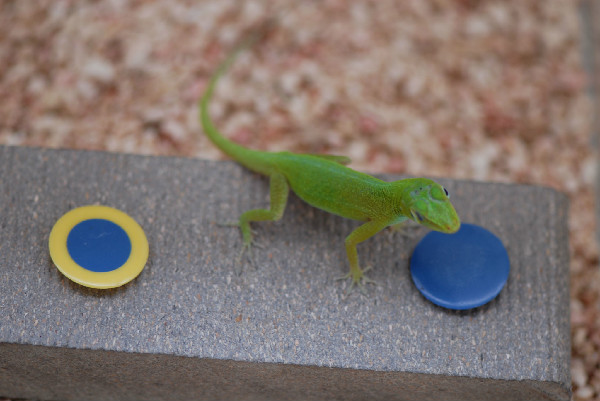
Manual Leal, a professor at Duke University, led a study in which six anoles were given a series of challenges designed to test their behavior flexibility, cognitive abilities and memory.  In these experiments, the lizards were presented with a platform containing two wells, one containing a food reward and the other empty. The wells were covered with tight-fitting opaque discs of differing colors and patterns, and the lizards were given 15 minutes to obtain the reward.

Anole Lizard: will you quit messing with my dinner if I drop that whole GEICO thing? (photo credit: Manuel Leal, Duke University)

According to Leal’s research paper, which was published online on July 13, 2011, in the Journal of the Royal Society: Biology Letters1, two-thirds of the lizards were able to solve the puzzle and find the food reward, a “completely unexpected” result since:

The correct response required major changes to what has previously been considered highly stereotyped foraging behavior, which consists of scanning the environment for moving prey items and striking them from above. In our experiment, motion cues were absent and striking from above was ineffective at dislodging the disc. Lizards used multiple strategies to remove the disc. The first was a modified strike, laterally biting the disc and lifting it away from the reward. The second strategy required the lizard to advance on the disc with its head held against the substrate, using its snout as a lever to push the disc out of the way…. This strategy is not a natural foraging behaviour that has at least been witnessed, and may demonstrate an entirely novel solution, which is one of the main criteria used to recognize behavioural flexibility.

Here’s a video from the New Scientist2 that shows one of the lizards in action:

When the tests were repeated with the disc colors associated with the reward reversed, two of the lizards continued to flip the original disc in an unsuccessful search for the reward, but the remaining two, nicknamed Plato and Socrates by Leal’s team, figured out that the discs had been changed and solved the problem again, reversing their previously learned color associations. (This sort of test is known as a “reversal learning” test.) Although there haven’t been many studies of cognition in reptiles, Plato and Socrates’ success appears to be particularly notable since prior evidence had suggested that reptiles do better at solving puzzles involving location change than ones involving altered visual cues.

Finally, Leal and his team were surprised to discover that the anoles were able to solve the challenges presented in these experiments in only one-third the attempts needed by birds given similar tasks in comparable experiments. While the researchers did not draw any definitive conclusions about this, they did note that, due to the slower metabolisms of the cold-blooded anoles, they could be tested only one time a day, and that the tempo at which the tests were performed might have some bearing on the number of attempts required.

Perhaps because people don’t expect displays of cognitive flexibility in reptiles, Leal’s research has generated a fair bit of media attention, including articles in The Economist3, ScienceNOW4MSNBC5, BBC Nature News6 and LiveScience7. Enjoy!

Now, after a long week, I think I’m going to go out and lie on a warm rock and then get some dinner.

_____

1Leal M, & Powell BJ (2011). Behavioural flexibility and problem-solving in a tropical lizard. Biology letters PMID: 21752816.

2New Scientist, “Smart lizard solves a problem it’s never seen before,” July 13, 2011.

3The Economist, “Cold Blooded Cunning,” July 14, 2011.

4ScienceNOW, “Tropical Lizards Get Brainy,” July 12, 2011.

5MSNBC, “Don’t underestimate the brainpower of a lizard,” July 13, 2011.

6BBC Nature News, “Lizard has problem solving skills,” July 13, 2011.

7LiveScience, “Lizards Are Wizards At Solving Food Puzzle,” July 12, 2011.

Did You Hear the One About the Traveling Salesman and the Bumblebee?

Last fall, bumblebees enjoyed their moment in the sun, as a series of headlines proclaimed that they were mathematical geniuses:

“Tiny Bee Brains Beat Computers at Complex Math Problems”
Fox News1

“Bees Solve Complex Problems Faster Than Supercomputers”
The Daily Galaxy2

“Bees’ brains more powerful than computers”
Natural News3

Bumblebee solving quadratic equations (photo: U.S. Fish & Wildlife Service)

What was all the fanfare about? Are we about to enter a new era in which paparazzi stalk bees rather than reality TV stars? (We won’t complain if this is the case.) PhysOrg.com4 summarized the context as follows:

Scientists at Queen Mary, University of London and Royal Holloway, University of London have discovered that bees learn to fly the shortest possible route between flowers even if they discover the flowers in a different order. Bees are effectively solving the ‘Travelling Salesman Problem’, and these are the first animals found to do this.

The Travelling Salesman must find the shortest route that allows him to visit all locations on his route. Computers solve it by comparing the length of all possible routes and choosing the shortest. However, bees solve it without computer assistance using a brain the size of grass seed.

Professor Lars Chittka from Queen Mary’s School of Biological and Chemical Sciences said: “In nature, bees have to link hundreds of flowers in a way that minimises travel distance, and then reliably find their way home – not a trivial feat if you have a brain the size of a pinhead! Indeed such travelling salesmen problems keep supercomputers busy for days. Studying how bee brains solve such challenging tasks might allow us to identify the minimal neural circuitry required for complex problem solving.”

In actuality, the bumblebees’ achievements, while impressive, were a bit more modest than publicized.

Bumblebees (Bombus terrestris) do indeed visit flowers in predictable sequences called “traplines,” and the UK research team wanted to learn more about whether these sequences simply reflect the order in which flowers are discovered or whether they result from more complex navigational strategies enabling bees to optimize their foraging routes. Accordingly, the researchers set up an array consisting of four (not hundreds of) artificial flowers, which they introduced to bumblebees in sequence.

The researchers observed that over time the bees tended to stop visiting the artificial flowers in their discovery order and, through a process of trial and error, began reorganizing their preferred routes to minimize total flight distance. In general, the bumblebees adopted a primary route and two or three less frequently used secondary routes, with the primary route typically being the shortest distance route. The bees also did a (reasonably) good job of remembering the most efficient route after an overnight break.

Even though the bees gravitated toward the shortest route, they did continue to experiment with novel routes, a behavior that – the researchers hypothesized – might allow them to fine tune their behavior as new sources of food were found over time.

Now, in their research paper5, the UK team did note that the bees’ search to find the shortest path among flowers is analogous to the traveling salesman problem, and did state that “Our findings suggest that traplining animals can find (or approach) optimal solutions to dynamic traveling salesman problems (variations of the classic problem where availability of sites changes over time) simply by adjusting their routes by trial and error in response to environmental changes.” These observations are, however, just a tad less dramatic than the “triumph over supercomputers” celebrated in the popular media reports on the research.

So what are the morals of this story?

  • While all too often animals are derided as “dumb beasts” and the like, sometimes we go in the opposite direction, overstating what animals are capable of accomplishing in order to create a sensation.
  • Even without the hyperbole, bumblebee route optimization behavior is noteworthy. There are often multiple ways to solve difficult problems, and sometimes the efficient approaches developed by animals who do not boast large brains can be surprisingly effective.
  • Insects, both in collective groups and as individuals, seem to be particularly adept at finding rational solutions that have an almost mathematical feel to them.
  • Bumblebees can sure generate a lot of buzz.

_____

1Fox News, “Tiny Bee Brains Beat Computers at Complex Math Problems,” October 25, 2010.

2The Daily Galaxy, “Bees Solve Complex Problems Faster Than Supercomputers,” October 26, 2010.

3Natural News, “Bees’ brains more powerful than computers,” October 27, 2010.

4PhysOrg.com, “Complex mathematical problem solved by bees,” October 25, 2010.

5Lihoreau M, Chittka L, & Raine NE (2010). Travel optimization by foraging bumblebees through readjustments of traplines after discovery of new feeding locations. The American naturalist, 176 (6), 744-57 PMID: 20973670.

Does Berlitz Offer a Course in Prairie Dog?

Yes, that’s right – before your next trip to Arizona you may need to learn another language if you really want to be able to communicate with the natives.

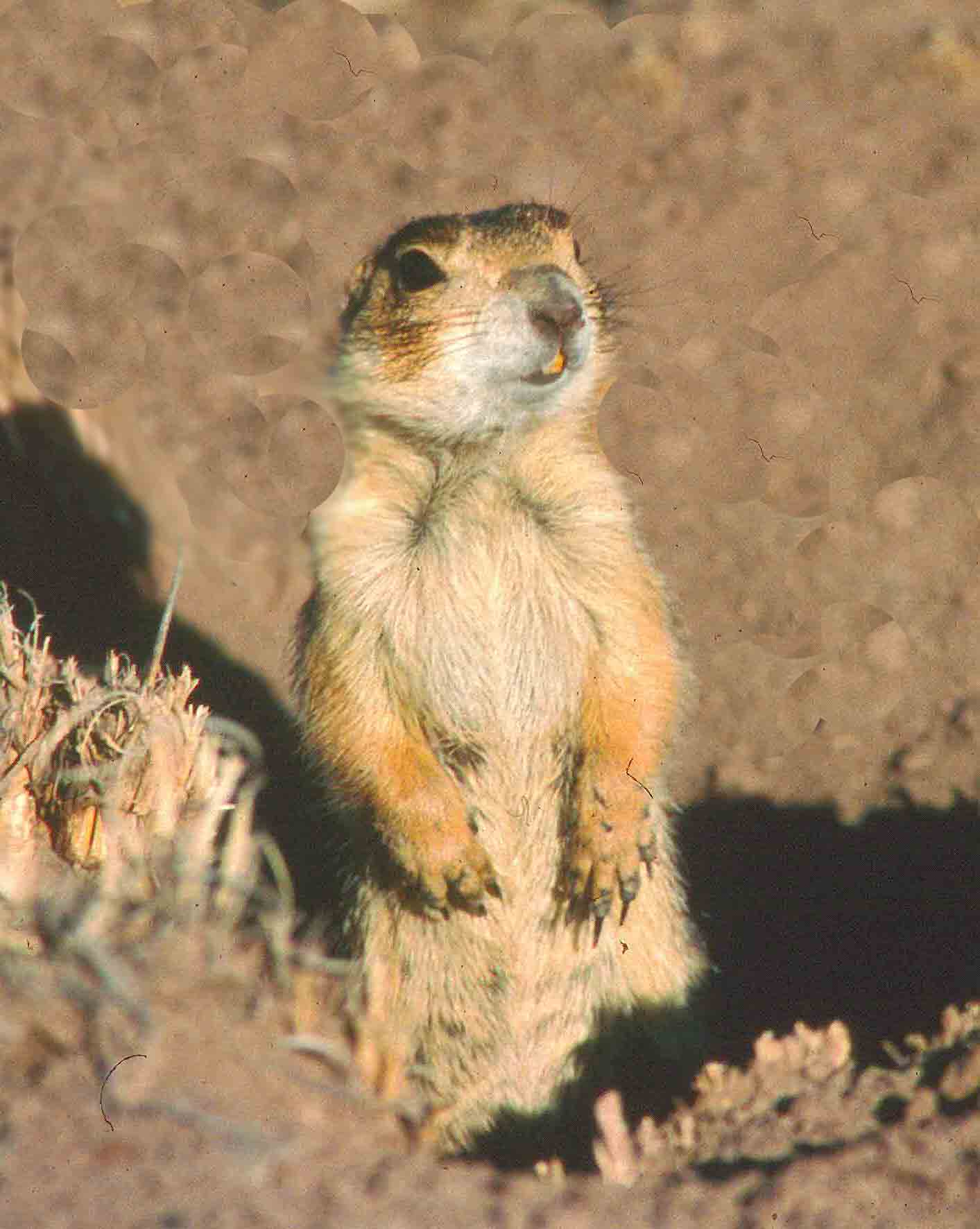
Prairie dog about to raise its hand in English class (photo credit: Northern Arizona University/Con Slobodchikoff)

Professor Con Slobodchikoff of Northern Arizona University has been studying Gunnison’s prairie dogs for the last three decades, and, as reported by BBC News1, believes that these social rodents have some very special language abilities. Slobodchikoff told the BBC:

Prairie dogs have the most complex natural language that has been decoded so far. They have words for different predators, they have descriptive words for describing the individual features of different predators, so it’s a pretty complex language that has a lot of elements.

According to the BBC article:

The researchers found that the prairie dogs are confronted by so many predators that they have evolved different “words” to describe them all.

These words are barks and sounds that contain different numbers of rhythmic chirps and frequency modulations.

Individual prairie dogs have different tonal qualities, just as human voices differ, but different rodents use the same words to describe the same predators, allowing the alarm call to be understood by the rest of the colony.

For example, a single bark may be attuned to say “tall, skinny coyote in distance, moving rapidly towards colony”.

National Public Radio (NPR)2 recently featured Slobodchikoff’s prairie dog research as well, providing additional color about how Slobodchikoff and his students hid near prairie dog villages, used microphones to record shrill prairie dog predator warning cries (“It sounds kind of like ‘chee chee chee chee,’ “ says Slobodchikoff), and then analyzed the sounds using computer programs to parse out the differing frequencies and overtone layers of the prairie dogs’ warnings made in response to humans, dogs, coyotes, hawks and other perceived threats.

The NPR article describes how, after Slobodchikoff noticed that there were variations in the calls used to identify individual humans, he decided to perform further tests to see how specific the prairie dogs were being in describing what they saw:

He had four (human) volunteers walk through a prairie dog village, and he dressed all the humans exactly the same — except for their shirts. Each volunteer walked through the community four times: once in a blue shirt, once in a yellow, once in green and once in gray.

He found, to his delight, that the calls broke down into groups based on the color of the volunteer’s shirt. “I was astounded,” says Slobodchikoff. But what astounded him even more, was that further analysis revealed that the calls also clustered based on other characteristics, like the height of the human. “Essentially they were saying, ‘Here comes the tall human in the blue,’ versus, ‘Here comes the short human in the yellow,’ “says Slobodchikoff.

Amazingly, it doesn’t stop there. Slobodchikoff’s next move was to see if prairie dogs could differentiate between abstract shapes. So he and his students built two wooden towers on each side of a prairie dog village. They then made cardboard cutouts of circles, squares and triangles and ran them out along a wire strung between the two towers, so the shapes sort of floated through the village about three feet from the ground. And the prairie dogs, Slobodchikoff found, were able to tell the difference between the triangle and the circle, but, alas, they made no mention of the difference between the square and the circle.

Prairie dog warning system: "One if by land, two if by sea" (photo credit: U.S. Fish & Wildlife Service)

As the BBC puts it, if Slobodchikoff’s conclusions are correct, it would mean that “the chattering rodents communicate in a more complex way than even monkeys or dolphins.”

Pretty impressive stuff.

What do you think, does prairie dog communication amount to speaking a “language”? Is human language unique in some fundamental sense, or is there a continuum between what the prairie dogs are telling each other and what we talk about among ourselves?

We will have future posts regarding animal communication and linguistic abilities, and further explore the nature of language.  Until next time, chee chee chee chee, and to all a good night!

_____

1BBC News, “Burrowing US prairie dogs use complex language,” February 2, 2010.

2NPR, “New Language Discovered: Prairiedogese,” January 20, 2011.

Tooling Around Underwater

Tool Time For Tuskfish

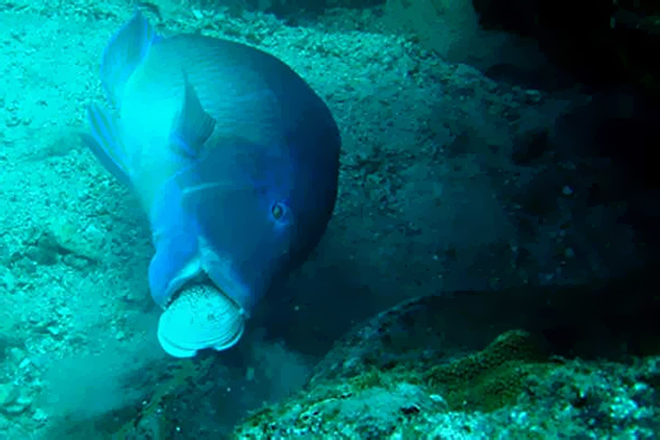
As reported last week in ScienceNOW1, a professional diver exploring the Great Barrier Reef off the coast of Australia recently snapped the first photos of a fish using tools. The diver, Scott Gardner, came across a blackspot tuskfish (Choerodon schoenleinii) that was hovering over a sandy area near a rock with a clam in its mouth. The tuskfish rolled on its side and, with a repeated cracking noise, slammed the clam against the rock until the shell fractured. Here’s one of the photos that Gardner took of the industrious (and hungry) tuskfish:

Tuskfish cracking open clam (photo credit: Scott Gardner)

While there have been anecdotal accounts of other fish using tools, this is the first time that this type of behavior has been caught on film.

What Is Tool Use, Anyhow?

In an interesting aside, this incident has brought to the forefront some of the ways in which it is difficult to define, and reach agreement upon, exactly what constitutes “tool use” in animals.  As noted in the ScienceNOW article, there has been previous debate over whether stingrays and archerfish targeting jets of water to capture prey constitutes tool use (is a solid external object necessary for there to be a tool?), as well as whether tool use “requires the animal to hold or carry the tool itself, in this case the rock.”

The research paper regarding this tuskfish behavior, which was published in the most recent issue of Coral Reefs2, the official Journal of the International Society for Reef Studies, argues that the tuskfish using the rock as an anvil to open the clam conforms to a definition of tool use first formulated by Jane Goodall back in 1970, that tool use is “the use of an external object as a functional extension of mouth or hand in the attainment of an immediate goal.” The paper adds: “The use of a rock as an anvil rather than a hammer could be considered a sign of intelligence considering the ineffectiveness of manipulating a freely suspended tool in water. The images certainly provide an interesting starting point for further comparative studies on tool use in fishes.”

The ScienceNOW article describes how Culum Brown, a behavioral ecologist at Macquarie University in Sydney, Australia, and a co-author of the Coral Reefs paper:

argues that it’s not logical to apply the same rules to fish as to primates or birds. For one thing, fish don’t have anything but their mouths to manipulate tools with, and for another, water poses different physical limitations than air. ‘One of the problems with the definition of tool use as it currently stands is it’s totally written for primates,’ he says. ‘You cannot swing a hammer effectively underwater.’

Those of you who pay close attention may already have noted that the definition of tool use can stir controversy. For example, beginning at the 10:34 mark in her video presentation relating to the awesome octopus, Maggie Koerth-Baker describes two very divergent definitions that might lead to different conclusions about whether the octopus engages in tool use: (a) a stricter definition that requires that an animal use a solid object to solve an “immediate problem,” rather than just to provide defense, and (b) a broader definition holding that tool use occurs whenever an animal modifies an object so as to alter some aspect of its environment.

Food For Thought

In considering tool use by animals, here are some things you might want to ponder:

  • Which of the above definitions makes the most sense to you?
  • Does it matter whether the behavior is performed by a captive animal (like the New Caledonian crow) or in the wild?
  • Are definitions of tool use inherently anthropocentric and subjective? That is, are we trying to come up with a definition that basically requires the behavior to look like something a human would do (if it really is a tool, then I should be able to see the Craftsman logo) before we accept it?
  • Is it significant whether the behavior is widespread? That is, if the behavior is only observed once or twice, is it a fluke? If the behavior is widespread, is it mere instinct?
  • Is nest building by birds an example of tool use?

Conclusion

There will undoubtedly be more AnimalWise posts about tool use. In the meantime, if you run across any tuskfish, you should look very closely to see if you can see their very small, teeny-tiny tool belts. They really are quite cute.

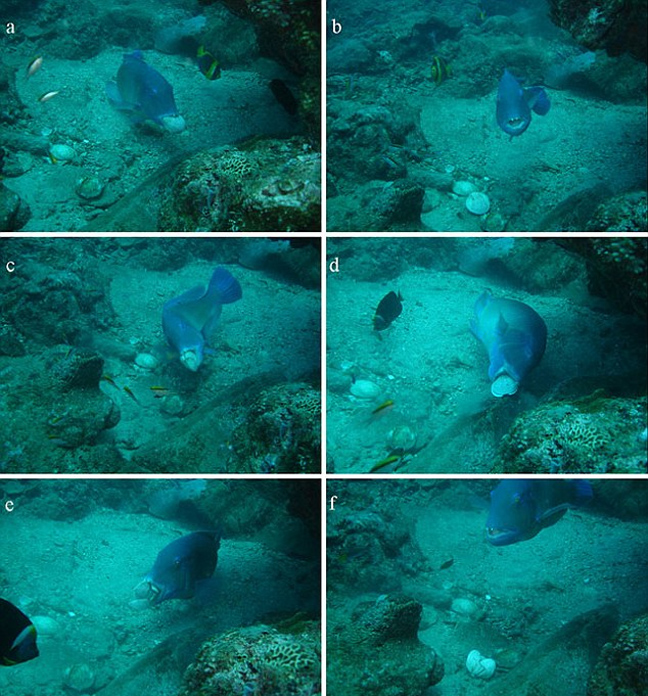
Here are some more photos (note, the following pictures may not be suitable for small children and clams):

More Scenes from "Crouching Tuskfish, Hidden Clam" (photo credit: Scott Gardner)

_____

1ScienceNOW, “Diver Snaps First Photo of Fish Using Tools,” July 8, 2011.

2Jones, A.M., Brown, C., Gardner, S. Tool use in the tuskfish Choerodon schoenleiniiCoral Reefs. DOI:10.1007/s00338-011-0790-y.

Something to Crow About

Some of you may be aware that crows (who are corvids, like magpies and Clark’s Nutcrackers) are excellent problem solvers and that they are one of the few birds known to engage in tool use.

While there have been a variety of popular press articles describing tool use by New Caledonian crows, in this post I wanted to showcase a few videos that demonstrate visually just how impressive these crows are.

The first video features a New Caledonian crow creating a bent wire hook to fish out a food treat after realizing that a straight piece of wire won’t do the trick. Check it out; it’s pretty incredible:

In a second demonstration of cognitive abilities, the crow employs a sequence of three tools to obtain food reward – using a short stick to withdraw a medium-length stick, using the medium-length stick to obtain a long stick, and then using the long stick to reach the food. As the video notes, this is the first time a non-human animal with no explicit training has been observed using three different tools in the correct sequence to achieve a goal. Again, the video illustrates this feat quite nicely:

Finally, a recent Wired1 article, together with accompanying video, features a New Caledonian crow finding a novel use for a tool, poking a rubber spider. This sort of flexible tool use is quite rare, and crows are the first non-mammals who have demonstrated that they can use a single tool in multiple ways. Here’s the video:

I love how the crow gingerly pokes at the rubber spider and then jumps back – talk about a a familiar looking reaction!

For more information and videos relating to tool usage by New Caledonian crows, you can explore the tool use website2 of the Behavioural Ecology Research Group at the University of Oxford.

_____

1Wired, “Clever Crows Use Tools in New Way,” January 5, 2011.

2Visited on July 11, 2011.

Spotted Hyenas: Clever Carnivores, Not Simply Comedians

Underestimated by many, spotted hyenas (Crocuta crocuta) are providing insight into the roots of human intelligence.

Far from being clownish buffoons, spotted hyenas – also known as laughing hyenas – live in large, complex matriarchal communities, or clans, in which social intelligence is critical. They are fascinating animals – although they look something like dogs, they are more closely related to cats, and closer still to mongooses and civets. Female spotted hyenas are the true clan leaders: they are larger and more aggressive than males, socially dominant, and have even evolved to have male-like external features, including a pseudopenis that is extremely similar in appearance to the male’s sexual organ.

Spotted hyenas enjoying the water (photo credit: K. Holekamp)

Kay Holekamp, a professor of zoology at Michigan State University, has been studying these gregarious carnivores for many years, and is particularly focused on how they can help us gain a better understanding of why certain animals, including humans and other primates, have developed high intelligence and large brains (which, from a metabolic standpoint, are extremely expensive to maintain). More specifically, she has been looking at spotted hyena society as a means of probing the “social complexity” theory of intelligence, which posits that brainpower provides a significant edge to animals living in complex social groups, where individuals need to be able to anticipate, respond to and manipulate the social behavior of other group members.

The majority of intelligence research in this area has been performed on primates, but Holekamp notes in recent research1 that social complexity theory predicts that “if indeed the large brains and great intelligence found in primates evolved in response to selection pressures associated with life in complex societies, then cognitive abilities and nervous systems with primate-like attributes should have evolved convergently in non-primate mammals living in large, elaborate societies in which individual fitness is strongly influenced by social dexterity.”

In this research, Holekamp acknowledges that much remains to be learned about social cognition in spotted hyenas, but concludes:

Work to date on spotted hyenas has shown that they live in social groups just as large and complex as those of cercopithecine primates [AW: a subfamily of Old World monkeys], that they experience an extended early period of intensive learning about their social worlds like primates, that the demand for social dexterity during competitive and cooperative interactions is no less intense than it is in primates, and that hyenas appear to be capable of many of the same feats of social recognition and cognition as are primates.

While the paper includes much more detail, the following are among Holekamp’s observations regarding spotted hyena social knowledge and skills:

  • Individual recognition. Spotted hyenas possess a rich repertoire of visual, acoustic and olfactory signals, which other hyenas can use to discriminate clan members from alien hyenas, to recognize the other members of their social units as individuals and to obtain information about signalers’ affect and current circumstances.
  • Kin recognition.Hyenas can distinguish vocalizations of kin from those of non-kin, with intensity of responses increasing with degree of relatedness between vocalizing and listening animals, and kin recognition potentially occurring among hyenas as distantly related as great-aunts and cousins.

    Basking spotted hyena cub (photo credit: K. Holekamp)

  • Imitation and behavior coordination. Although hyenas have not been observed to engage in true imitation (that is, replicating a novel act performed by a species member) the way some primates do, they do appear to modify their behavior after observing goal-directed behavior of other hyenas. In addition, they engage in cooperative hunting involving complex coordination and division of labor among hunters. This cooperation, which enables them to capture prey many times their size, involves – at a minimum – communicating by simple rules of thumb (e.g., “move as necessary to keep the prey between you and another hunter”), if not the operation of higher mental processes.
  • Social rank and social memory. Spotted hyenas are intensely aware of social rank, and they learn quickly where they and their relatives fit into their clan’s dominance hierarchy. They are able to remember previous interactions they have had with other individuals, and appear to remember the identities and ranks of their clan mates throughout their lives. They apply their knowledge of social ranks in many ways, including to avoid conflict, figure out feeding priority, help them choose appropriate mates, determine which social relationships are desirable to establish and maintain, and when to reconcile after conflicts have occurred.
  • Flexible problem-solving. Similar to certain primates, it appears that spotted hyenas are able to achieve short-term goals through a variety of different tactics. As stated in the Holekamp’s research article, “For example, a hyena can avoid aggression by leaving the aggressor’s subgroup, exhibiting appeasement behavior or distracting the aggressor. A hyena can potentially use greeting ceremonies to reconcile fights, reintroduce itself to conspecifics [AW: members of their own species] from which it has been separated, or increase conspecifics’ arousal levels in preparation for a border patrol or group hunt.”
  • Tactical deception. One sign of social cleverness, which should be familiar to all humans, is tactical deception. It appears that hyenas may share this sophisticated behavior as well, as anecdotal accounts of hyena deception include a low-ranking hyena noticing an unprotected meal but ignoring it until higher-ranking group mates were out of range, and other low-ranking individuals similarly emit alarm vocalizations in what appear to be deceptive attempts to gain access to food.

Finally, here’s a brief video in which Holekamp shows one of the ways she and her colleagues have been assessing the puzzle-solving skills and memories of spotted hyenas:

So, hats off to laughing hyenas: they may sound comical, but they are seriously smart!

_____

1Holekamp, K., Sakai, S., & Lundrigan, B. (2007). Social intelligence in the spotted hyena (Crocuta crocuta) Philosophical Transactions of the Royal Society B: Biological Sciences, 362 (1480), 523-538 DOI: 10.1098/rstb.2006.1993.

Charismatic Megafauna Day – Surfing Dolphins!

It’s Charismatic Megafauna Day here at AnimalWise!

As regular readers know, this blog is dedicated to animals of all stripes (and spots). Animal intelligence isn’t limited to the mammals; animal value does not require fur; animal awesomeness can arrive without an endoskeleton; and sometimes animal insight wears feathers. Rest assured that future posts will continue to introduce remarkable capabilities and amazing behaviors in all sorts of creatures, some well-known and considered attractive, others less familiar perhaps a bit frightening looking.

CMF Day, though, is an opportunity for us to shamelessly seek attention by featuring leading celebrities of the animal world. On CMF Day, pandas and elephants and whales reign supreme. Lions and tigers and bears, oh my!

I can't help smiling

So, on this inaugural Charismatic Megafauna Day, the spotlight is on the playful bottlenose dolphin. As the video below observes, dolphins are one of the very few species that continues to play into adulthood, and play can be an indication of an inventive brain and a restless mind. Play may also strengthen social bonds. Mostly, however, it’s just fun.

Surf’s up!

The Rational Ant

In a recent post I described how pigeons are better than humans at solving the Monty Hall problem and might therefore prove to be formidable competitors on Let’s Make a Deal. In this post, I have some good news and some bad news for those of you readers who are human (I make no assumptions in this blog). The good news is that I have yet to see any research showing that pigeons can triumph over humans at Jeopardy. The bad news is that the top two winners on Let’s Make a Deal could well end up being a pigeon and an ant, leaving the human contestants to go home with nothing more than an electronic version of the game (and perhaps a goat or two).

An article in ScienceNOW1 provides the backdrop:

Ants enjoying a nectar lunch on a sunny day (photo: Wikipedia)

Consider the following scenario: You want to buy a house with a big kitchen and a big yard, but there are only two homes on the market–one with a big kitchen and a small yard and the other with a small kitchen and a big yard. Studies show you’d be about 50% likely to choose either house–and either one would be a rational choice. But now, a new home comes on the market, this one with a large kitchen and no yard. This time, studies show, you’ll make an irrational decision: Even though nothing has changed with the first two houses, you’ll now favor the house with the big kitchen and small yard over the one with the small kitchen and big yard. Overall, scientists have found, people and other animals will often change their original preferences when presented with a third choice.

Not so with ants. These insects also shop for homes but not quite in the way that humans do. Solitary worker ants spread out, looking for two main features: a small entrance and a dark cavity. If an ant finds an outstanding hole–such as the inside of an acorn or a rock crevice–it recruits another scout to check it out. As more scouts like the site, the number of workers in the new hole grows. Once the crowd reaches a critical mass, the ants race back to the old nest and start carrying the queen and larvae to move the entire colony.

The article goes on to describe some research on ant decision-making conducted by Stephen Pratt, an Arizona State University behavioral ecologist, and Susan Edwards, of the Department of Ecology and Evolutionary Biology at Princeton University. In this research, published in Proceedings of the Royal Society: Biological Sciences2, Pratt and Edwards designed a series of possible nests for 26 ant colonies:

The duo cut rectangular holes in balsa wood and covered them with glass microscope slides. The researchers then drilled holes of various sizes into the glass slides and slipped plastic light filters under the glass to vary the features ants care about most. At first, the colonies only had two options, A and B. A was dark but had a large opening, whereas B was bright with a small opening. As with humans, the ants preferred both options equally: The researchers found no difference between the number of colonies that picked A versus B.

Then the scientists added a third option, called a decoy, that was similar to either A or B in one characteristic but clearly worse than both in the other (a very bright nest with a small opening, for example). Unlike humans, the ants were not tricked by the decoy, the team reports online today in the Proceedings of the Royal Society B. Although a few colonies picked the third nest, the other colonies did not start favoring A or B and still split evenly between the two.

Ants can make better decisions because they take advantage of collective wisdom and do not “overthink” their options the way humans are prone to do. As Pratt noted in an article published in PhysOrg.com3, “Typically we think having many individual options, strategies and approaches are beneficial, but irrational errors are more likely to arise when individuals make direct comparisons among options.”

This research is particularly fascinating in that it poses a direct challenge to our core belief that we will always enjoy a large advantage over other animals when there is an intellectual way to solve a problem: sure, animals may have highly-evolved senses of smell, they may be fast, they may have impressive reflexes and their instincts may be powerful, but where we humans are able to harness our large brains, we will inevitably prevail.

In fact, though, we should hold off before patting ourselves on the back. As this (and other) research shows, we suffer from biases and flaws in the way we approach thought problems that can lead to irrational decisions and that can even put us at a disadvantage vis-à-vis other animals, including the birds and the ants.

Something to think about.

_____

1ScienceNOW, “Can’t Decide? Ask an Ant,” July 22, 2009.

2Edwards SC, Pratt SC. Rationality in collective decision-making by ant colonies. Proc Biol Sci. 2009 October 22; 276(1673): 3655–3661, published online 2009 July 22 (doi: 10.1098/rspb.2009.0981).

3PhysOrg.com, “Ants more rational than humans,” July 24, 2009.