Does Berlitz Offer a Course in Prairie Dog?

Yes, that’s right – before your next trip to Arizona you may need to learn another language if you really want to be able to communicate with the natives.
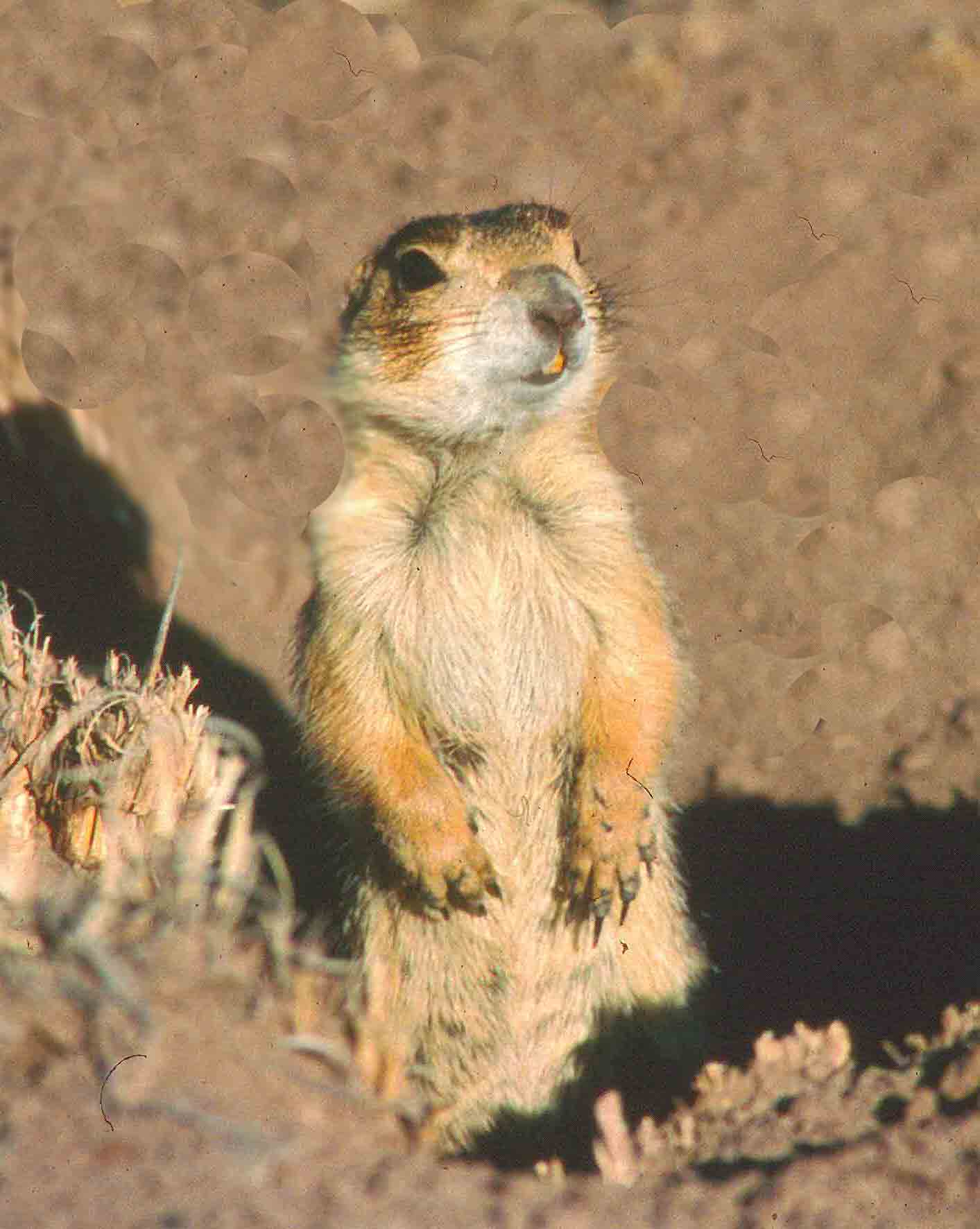
Prairie dog about to raise its hand in English class (photo credit: Northern Arizona University/Con Slobodchikoff)

Professor Con Slobodchikoff of Northern Arizona University has been studying Gunnison’s prairie dogs for the last three decades, and, as reported by BBC News1, believes that these social rodents have some very special language abilities. Slobodchikoff told the BBC:

Prairie dogs have the most complex natural language that has been decoded so far. They have words for different predators, they have descriptive words for describing the individual features of different predators, so it’s a pretty complex language that has a lot of elements.

According to the BBC article:

The researchers found that the prairie dogs are confronted by so many predators that they have evolved different “words” to describe them all.

These words are barks and sounds that contain different numbers of rhythmic chirps and frequency modulations.

Individual prairie dogs have different tonal qualities, just as human voices differ, but different rodents use the same words to describe the same predators, allowing the alarm call to be understood by the rest of the colony.

For example, a single bark may be attuned to say “tall, skinny coyote in distance, moving rapidly towards colony”.

National Public Radio (NPR)2 recently featured Slobodchikoff’s prairie dog research as well, providing additional color about how Slobodchikoff and his students hid near prairie dog villages, used microphones to record shrill prairie dog predator warning cries (“It sounds kind of like ‘chee chee chee chee,’ “ says Slobodchikoff), and then analyzed the sounds using computer programs to parse out the differing frequencies and overtone layers of the prairie dogs’ warnings made in response to humans, dogs, coyotes, hawks and other perceived threats.

The NPR article describes how, after Slobodchikoff noticed that there were variations in the calls used to identify individual humans, he decided to perform further tests to see how specific the prairie dogs were being in describing what they saw:

He had four (human) volunteers walk through a prairie dog village, and he dressed all the humans exactly the same — except for their shirts. Each volunteer walked through the community four times: once in a blue shirt, once in a yellow, once in green and once in gray.

He found, to his delight, that the calls broke down into groups based on the color of the volunteer’s shirt. “I was astounded,” says Slobodchikoff. But what astounded him even more, was that further analysis revealed that the calls also clustered based on other characteristics, like the height of the human. “Essentially they were saying, ‘Here comes the tall human in the blue,’ versus, ‘Here comes the short human in the yellow,’ “says Slobodchikoff.

Amazingly, it doesn’t stop there. Slobodchikoff’s next move was to see if prairie dogs could differentiate between abstract shapes. So he and his students built two wooden towers on each side of a prairie dog village. They then made cardboard cutouts of circles, squares and triangles and ran them out along a wire strung between the two towers, so the shapes sort of floated through the village about three feet from the ground. And the prairie dogs, Slobodchikoff found, were able to tell the difference between the triangle and the circle, but, alas, they made no mention of the difference between the square and the circle.

Prairie dog warning system: "One if by land, two if by sea" (photo credit: U.S. Fish & Wildlife Service)

As the BBC puts it, if Slobodchikoff’s conclusions are correct, it would mean that “the chattering rodents communicate in a more complex way than even monkeys or dolphins.”

Pretty impressive stuff.

What do you think, does prairie dog communication amount to speaking a “language”? Is human language unique in some fundamental sense, or is there a continuum between what the prairie dogs are telling each other and what we talk about among ourselves?

We will have future posts regarding animal communication and linguistic abilities, and further explore the nature of language.  Until next time, chee chee chee chee, and to all a good night!

_____

1BBC News, “Burrowing US prairie dogs use complex language,” February 2, 2010.

2NPR, “New Language Discovered: Prairiedogese,” January 20, 2011.

Spotted Hyenas: Clever Carnivores, Not Simply Comedians

Underestimated by many, spotted hyenas (Crocuta crocuta) are providing insight into the roots of human intelligence.

Far from being clownish buffoons, spotted hyenas – also known as laughing hyenas – live in large, complex matriarchal communities, or clans, in which social intelligence is critical. They are fascinating animals – although they look something like dogs, they are more closely related to cats, and closer still to mongooses and civets. Female spotted hyenas are the true clan leaders: they are larger and more aggressive than males, socially dominant, and have even evolved to have male-like external features, including a pseudopenis that is extremely similar in appearance to the male’s sexual organ.

Spotted hyenas enjoying the water (photo credit: K. Holekamp)

Kay Holekamp, a professor of zoology at Michigan State University, has been studying these gregarious carnivores for many years, and is particularly focused on how they can help us gain a better understanding of why certain animals, including humans and other primates, have developed high intelligence and large brains (which, from a metabolic standpoint, are extremely expensive to maintain). More specifically, she has been looking at spotted hyena society as a means of probing the “social complexity” theory of intelligence, which posits that brainpower provides a significant edge to animals living in complex social groups, where individuals need to be able to anticipate, respond to and manipulate the social behavior of other group members.

The majority of intelligence research in this area has been performed on primates, but Holekamp notes in recent research1 that social complexity theory predicts that “if indeed the large brains and great intelligence found in primates evolved in response to selection pressures associated with life in complex societies, then cognitive abilities and nervous systems with primate-like attributes should have evolved convergently in non-primate mammals living in large, elaborate societies in which individual fitness is strongly influenced by social dexterity.”

In this research, Holekamp acknowledges that much remains to be learned about social cognition in spotted hyenas, but concludes:

Work to date on spotted hyenas has shown that they live in social groups just as large and complex as those of cercopithecine primates [AW: a subfamily of Old World monkeys], that they experience an extended early period of intensive learning about their social worlds like primates, that the demand for social dexterity during competitive and cooperative interactions is no less intense than it is in primates, and that hyenas appear to be capable of many of the same feats of social recognition and cognition as are primates.

While the paper includes much more detail, the following are among Holekamp’s observations regarding spotted hyena social knowledge and skills:

  • Individual recognition. Spotted hyenas possess a rich repertoire of visual, acoustic and olfactory signals, which other hyenas can use to discriminate clan members from alien hyenas, to recognize the other members of their social units as individuals and to obtain information about signalers’ affect and current circumstances.
  • Kin recognition.Hyenas can distinguish vocalizations of kin from those of non-kin, with intensity of responses increasing with degree of relatedness between vocalizing and listening animals, and kin recognition potentially occurring among hyenas as distantly related as great-aunts and cousins.

    Basking spotted hyena cub (photo credit: K. Holekamp)

  • Imitation and behavior coordination. Although hyenas have not been observed to engage in true imitation (that is, replicating a novel act performed by a species member) the way some primates do, they do appear to modify their behavior after observing goal-directed behavior of other hyenas. In addition, they engage in cooperative hunting involving complex coordination and division of labor among hunters. This cooperation, which enables them to capture prey many times their size, involves – at a minimum – communicating by simple rules of thumb (e.g., “move as necessary to keep the prey between you and another hunter”), if not the operation of higher mental processes.
  • Social rank and social memory. Spotted hyenas are intensely aware of social rank, and they learn quickly where they and their relatives fit into their clan’s dominance hierarchy. They are able to remember previous interactions they have had with other individuals, and appear to remember the identities and ranks of their clan mates throughout their lives. They apply their knowledge of social ranks in many ways, including to avoid conflict, figure out feeding priority, help them choose appropriate mates, determine which social relationships are desirable to establish and maintain, and when to reconcile after conflicts have occurred.
  • Flexible problem-solving. Similar to certain primates, it appears that spotted hyenas are able to achieve short-term goals through a variety of different tactics. As stated in the Holekamp’s research article, “For example, a hyena can avoid aggression by leaving the aggressor’s subgroup, exhibiting appeasement behavior or distracting the aggressor. A hyena can potentially use greeting ceremonies to reconcile fights, reintroduce itself to conspecifics [AW: members of their own species] from which it has been separated, or increase conspecifics’ arousal levels in preparation for a border patrol or group hunt.”
  • Tactical deception. One sign of social cleverness, which should be familiar to all humans, is tactical deception. It appears that hyenas may share this sophisticated behavior as well, as anecdotal accounts of hyena deception include a low-ranking hyena noticing an unprotected meal but ignoring it until higher-ranking group mates were out of range, and other low-ranking individuals similarly emit alarm vocalizations in what appear to be deceptive attempts to gain access to food.

Finally, here’s a brief video in which Holekamp shows one of the ways she and her colleagues have been assessing the puzzle-solving skills and memories of spotted hyenas:

So, hats off to laughing hyenas: they may sound comical, but they are seriously smart!

_____

1Holekamp, K., Sakai, S., & Lundrigan, B. (2007). Social intelligence in the spotted hyena (Crocuta crocuta) Philosophical Transactions of the Royal Society B: Biological Sciences, 362 (1480), 523-538 DOI: 10.1098/rstb.2006.1993.

Charismatic Megafauna Day – Surfing Dolphins!

It’s Charismatic Megafauna Day here at AnimalWise!

As regular readers know, this blog is dedicated to animals of all stripes (and spots). Animal intelligence isn’t limited to the mammals; animal value does not require fur; animal awesomeness can arrive without an endoskeleton; and sometimes animal insight wears feathers. Rest assured that future posts will continue to introduce remarkable capabilities and amazing behaviors in all sorts of creatures, some well-known and considered attractive, others less familiar perhaps a bit frightening looking.

CMF Day, though, is an opportunity for us to shamelessly seek attention by featuring leading celebrities of the animal world. On CMF Day, pandas and elephants and whales reign supreme. Lions and tigers and bears, oh my!

I can't help smiling

So, on this inaugural Charismatic Megafauna Day, the spotlight is on the playful bottlenose dolphin. As the video below observes, dolphins are one of the very few species that continues to play into adulthood, and play can be an indication of an inventive brain and a restless mind. Play may also strengthen social bonds. Mostly, however, it’s just fun.

Surf’s up!

The Rational Ant

In a recent post I described how pigeons are better than humans at solving the Monty Hall problem and might therefore prove to be formidable competitors on Let’s Make a Deal. In this post, I have some good news and some bad news for those of you readers who are human (I make no assumptions in this blog). The good news is that I have yet to see any research showing that pigeons can triumph over humans at Jeopardy. The bad news is that the top two winners on Let’s Make a Deal could well end up being a pigeon and an ant, leaving the human contestants to go home with nothing more than an electronic version of the game (and perhaps a goat or two).

An article in ScienceNOW1 provides the backdrop:

Ants enjoying a nectar lunch on a sunny day (photo: Wikipedia)

Consider the following scenario: You want to buy a house with a big kitchen and a big yard, but there are only two homes on the market–one with a big kitchen and a small yard and the other with a small kitchen and a big yard. Studies show you’d be about 50% likely to choose either house–and either one would be a rational choice. But now, a new home comes on the market, this one with a large kitchen and no yard. This time, studies show, you’ll make an irrational decision: Even though nothing has changed with the first two houses, you’ll now favor the house with the big kitchen and small yard over the one with the small kitchen and big yard. Overall, scientists have found, people and other animals will often change their original preferences when presented with a third choice.

Not so with ants. These insects also shop for homes but not quite in the way that humans do. Solitary worker ants spread out, looking for two main features: a small entrance and a dark cavity. If an ant finds an outstanding hole–such as the inside of an acorn or a rock crevice–it recruits another scout to check it out. As more scouts like the site, the number of workers in the new hole grows. Once the crowd reaches a critical mass, the ants race back to the old nest and start carrying the queen and larvae to move the entire colony.

The article goes on to describe some research on ant decision-making conducted by Stephen Pratt, an Arizona State University behavioral ecologist, and Susan Edwards, of the Department of Ecology and Evolutionary Biology at Princeton University. In this research, published in Proceedings of the Royal Society: Biological Sciences2, Pratt and Edwards designed a series of possible nests for 26 ant colonies:

The duo cut rectangular holes in balsa wood and covered them with glass microscope slides. The researchers then drilled holes of various sizes into the glass slides and slipped plastic light filters under the glass to vary the features ants care about most. At first, the colonies only had two options, A and B. A was dark but had a large opening, whereas B was bright with a small opening. As with humans, the ants preferred both options equally: The researchers found no difference between the number of colonies that picked A versus B.

Then the scientists added a third option, called a decoy, that was similar to either A or B in one characteristic but clearly worse than both in the other (a very bright nest with a small opening, for example). Unlike humans, the ants were not tricked by the decoy, the team reports online today in the Proceedings of the Royal Society B. Although a few colonies picked the third nest, the other colonies did not start favoring A or B and still split evenly between the two.

Ants can make better decisions because they take advantage of collective wisdom and do not “overthink” their options the way humans are prone to do. As Pratt noted in an article published in PhysOrg.com3, “Typically we think having many individual options, strategies and approaches are beneficial, but irrational errors are more likely to arise when individuals make direct comparisons among options.”

This research is particularly fascinating in that it poses a direct challenge to our core belief that we will always enjoy a large advantage over other animals when there is an intellectual way to solve a problem: sure, animals may have highly-evolved senses of smell, they may be fast, they may have impressive reflexes and their instincts may be powerful, but where we humans are able to harness our large brains, we will inevitably prevail.

In fact, though, we should hold off before patting ourselves on the back. As this (and other) research shows, we suffer from biases and flaws in the way we approach thought problems that can lead to irrational decisions and that can even put us at a disadvantage vis-à-vis other animals, including the birds and the ants.

Something to think about.

_____

1ScienceNOW, “Can’t Decide? Ask an Ant,” July 22, 2009.

2Edwards SC, Pratt SC. Rationality in collective decision-making by ant colonies. Proc Biol Sci. 2009 October 22; 276(1673): 3655–3661, published online 2009 July 22 (doi: 10.1098/rspb.2009.0981).

3PhysOrg.com, “Ants more rational than humans,” July 24, 2009.

Fishing Buddies

We are all familiar with talented sports teams that underachieve because, despite the individual abilities of their players, they’ve been unable to “pull together” and coordinate their efforts effectively. Because teamwork requires cooperation, communication, and complex social interaction, we typically bring in outside coaches to create an environment that allows teamwork to develop, and we reserve our highest praise (and compensation) for those rare players who have the gift of making others better while being successful themselves (just ask Magic Johnson and Larry Bird).

With that in mind, you may be surprised to learn that a couple of the world’s most accomplished team players can be found not on the playing field or in the arena, but under the sea, and that they are members of different species of fish.

Grouper (from Wikipedia; photo credit: Jon Hanson)

In recent research published in PLoS Biology1, scientists reported on a highly coordinated and communicative hunting partnership between the grouper and the giant moray eel, which they observed in the coral reefs of the Red Sea. Together, the two fish make an extremely complementary and formidable hunting team.

Groupers, large predatory reef fish, are daytime hunters, while morays usually hunt at nght and rest in crevices during the day. Groupers typically hunt in open water near reefs and have trouble catching fish that hide in the holes and crevices that they find in the coral. Moray eels, on the other hand, sneak around reef crevices and attempt corner prey in holes, but have trouble catching fish in open water.

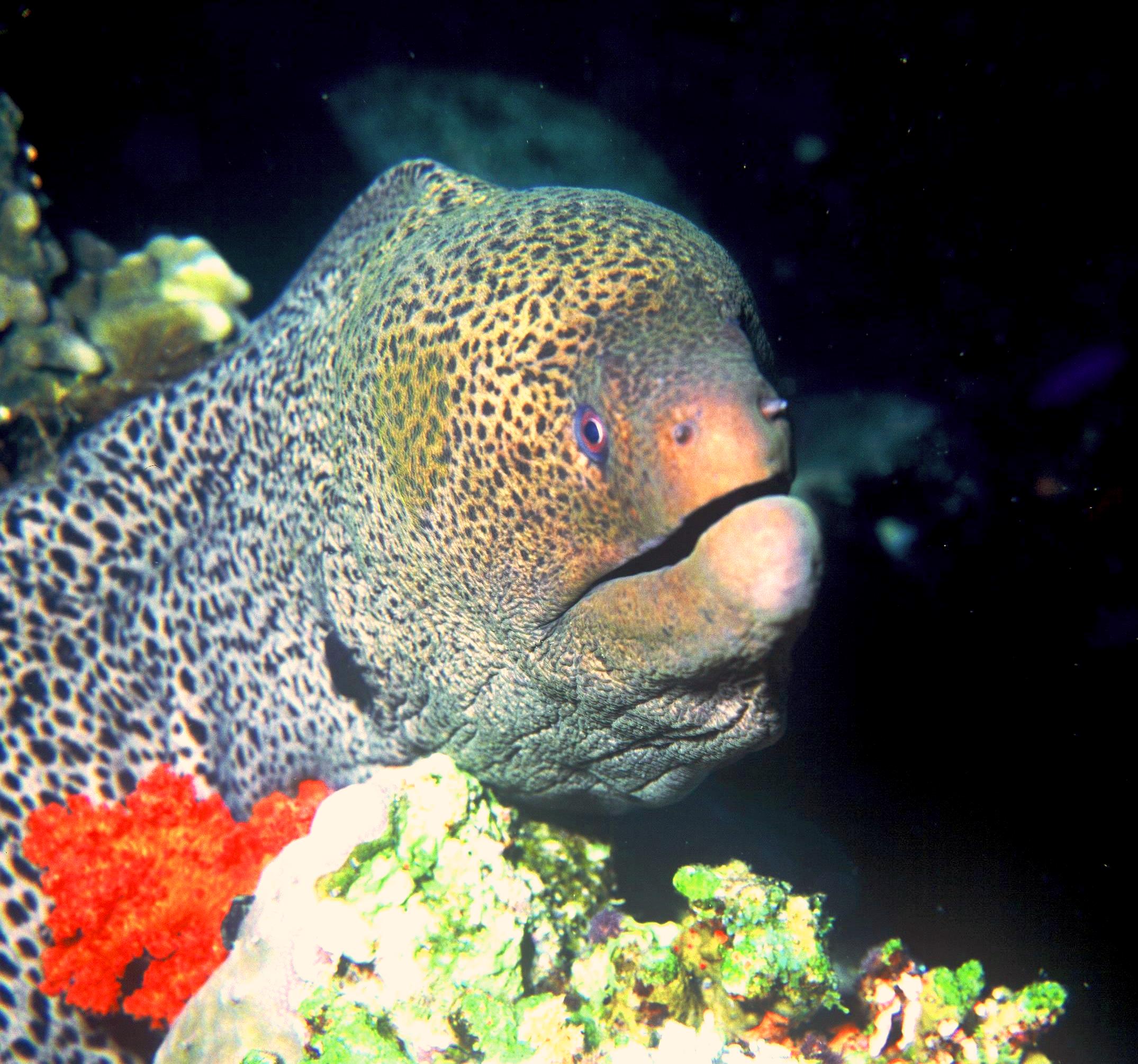
Giant Moray Eel (from Wikipedia; photo credit: Albert Kok)

As the research report observed: “The hunting strategies of the two predators are therefore complementary, and a coordinated hunt between individuals of the two species confronts prey with a multipredator attack that is difficult to avoid; prey are not safe in open water because of the grouper hunting strategy but cannot hide in crevices because of the moray’s mode of attack.”

The researchers found that hungry groupers would actively seek out their moray eel fishing partners in their crevices and shake their heads rapidly right in the eels’ faces to let them know that it was time to go for a hunt. Here’s a video of a grouper letting an eel know that it is time to eat.

The morays would then leave their hiding holes and swim off in search of food with the groupers. Here’s a video of the hunting twosome happily swimming off together for dinner.

Moreover, the pair would cooperate as they hunted. In some cases, for instance, a grouper would remain directly above a crevice where prey was hiding, perform “headstands” and shake its head to guide the moray eel to the hidden prey’s location.

The researchers noted that, when the two fish worked together as a team, the groupers caught five times as many fish as they did separately, and the moray eels caught almost twice as many fish as the groupers. (Because the morays normally hunt at night, the researchers didn’t observe them catching any fish separately, so they were not able to draw any conclusions regarding how their partnership with the groupers changed their hunting efficiency.)

This type of inter-species coordinated hunting with differentiated roles is extremely rare and had never been seen before in fish. If you think about it, this is pretty complex and advanced behavior, as the individuals must perform specific actions and play specific roles, knowing that their counterparts are doing the same. The groupers, with their intentional signaling to call their moray partners to the hunt and to direct them to prey, demonstrate particularly sophisticated, cognitively advanced behavior.

So, forget about your local sports franchise; if you want to see some especially impressive teamwork, you should put on your wetsuit and let some reef fish show you how it’s done.

_____

1Bshary R, Hohner A, Ait-el-Djoudi K, Fricke H. Interspecific Communicative and Coordinated Hunting between Groupers and Giant Moray Eels in the Red Sea. PLoS Biol 2006 4(12): e431. doi:10.1371/journal.pbio.0040431.

My Border Collie Is Smarter Than Your Honor Student

Or so the bumper sticker says.

On this Fourth of July, it seems appropriate to salute man’s best friend in a brief holiday post. Meet Chaser, a true canine linguistic champion.

Chaser understands more than 1,000 words, along with simple sentences. Her vocabulary includes the names of 1,022 objects, including 800 stuffed animals, 116 balls and 26 “Frisbees,” any of which she can fetch on command.

Chaser, resting after studying for the bar exam (photo credit: ABCNEWS.com)

In addition, if a new toy is placed among her playthings, she is able to retrieve it when given its unfamiliar name, inferring its identity by a process of exclusion. She also has been studying her verbs, demonstrating that she knows how to “find,” “nose” and “paw” each of her toys. I assume that next she will be working on her gerunds and finishing her mastery of the subjunctive mood.

Happy Fourth, Chaser!

You can read more about Chaser and see her in action in this ABC News1 story.

_____

1ABC News, “World’s Smartest Dog? Meet a Border Collie Whose Memory Astounds,” February 9, 2011.

A Smart Fish in a Dangerous Pond

Mistakes are the portals of discovery.
James Joyce

Do not fear mistakes. You will know failure. Continue to reach out.
Benjamin Franklin

Nice quotes, but I think I’ll just avoid making mistakes, thank you very much.
Stickleback Fish

When you or I make a mistake, we can seek comfort in witty sayings, self-help programs and expensive therapy sessions. When a nine-spined stickleback fish makes a mistake, it often ends up in the belly of another marine animal.

Nine-Spined Stickleback (BBC News)

Perhaps motivated by this rather unpleasant truth, sticklebacks – a small fish commonly found in North America, Europe and Asia – have developed some unusually sophisticated social learning capabilities. In particular, sticklebacks are able to compare the feeding behavior of other sticklebacks with their own experience and choose which fish to copy in order to find more food. This capability, sometimes referred to as a “hill climbing” strategy, has not been observed in any animals other than sticklebacks and humans … at least those humans who aren’t too busy making mistakes in order to enjoy character-building learning opportunities. More importantly (to the sticklebacks), this voyeuristic approach to feeding enables them to learn where to feed while relaxing in safe places rather than running a gauntlet of predators to search for feeding sites in the open.

In a study published in Behavioral Ecology1, English researchers placed 270 sticklebacks in a tank with two feeders, one of which – the “rich feeder” – supplied a lot more food than the other. The fish that learned to prefer the rich feeder were then allowed to watch other sticklebacks feeding in the same  tank but, this time, the rich feeder no longer provided more food (in some cases, it provided less food, in others it provided about the same amount of food). When the observing group was given another opportunity to feed, about 75% were “clever” enough to know from watching the other fish that they should avoid the formerly rich feeder if it was now giving out less food, choosing the new improved feeder instead. However, in situations where the change in feeders resulted in each providing roughly the same amount of food, the observers did not copy the other fish and stuck with their initial choice.

As reported in ScienceDaily2, the BBC News3, and the Guardian4, one of the authors, professor Kevin Laland from the School of Biology at St Andrews University, saluted the sticklebacks for their learning prowess: “Nine-spined sticklebacks may be the geniuses of the fish world. It’s remarkable that a form of learning found to be optimal in humans is exactly what these fish do.” Another researcher, Jeremy Kendal from Durham University’s anthropology department added: “Hill-climbing strategies are widely seen in human society whereby advances in technology are down to people choosing the best technique through social learning and improving on it, resulting in cumulative culture. But our results suggest brain size isn’t everything when it comes to the capacity for social learning.”

So, in a fish eat fish world where mistakes can be costly, we would be well advised to balance our trial by error tendencies against the wisdom of a species that has learned how to succeed without putting itself into jeopardy.

_____

1Jeremy R. Kendal, Luke Rendell, Thomas W. Pike, and Kevin N. Laland. Nine-spined sticklebacks deploy a hill-climbing social learning strategy. Behavioral Ecology, 2009; 20 (2): 238.

2ScienceDaily, “Common Fish Species Has ‘Human’ Ability To Learn,” June 17, 2009.

3BBC News, “‘Genius’ claim for sticklebacks,” June 17, 2009.

4The Guardian, “Sticklebacks show human-like intelligence when searching for food,” June 16, 2009.

Udderly Intelligent

While you might be willing to acknowledge that a cow can be out standing in its field, I’m willing to bet that you don’t typically think of Bessie as leading a rich intellectual and emotional life.  You might want to think again.

According to The Sunday Times1, “cows have a secret mental life in which they bear grudges, nurture friendships and become excited over intellectual challenges.” Moreover, cows don’t have a monopoly on farm animal intelligence, as the article reports similar findings for sheep, pigs, goats, chickens and other livestock.

Notable feats of barnyard intellectual prowess include:

  • Cows form friendship groups and spend most of their most of their timing licking, grooming and generally hanging out with a few other like-minded bovines.  They can also form dislikes and hold grudges “for months or years.” (Note to self: don’t get on the wrong side of a cow.)
  • Cows have become so excited in solving intellectual challenges such as figuring out how to open a door to get some food that their “brainwaves showed their excitement; their heartbeat went up and some even jumped into the air.” (Ok, that alone made this post worthwhile – I would pay to see a cow jump into the air as it solved a puzzle!)
  • Sheep can recognize up to 50 other sheep simply by looking at their profiles, and can remember the other sheep even after a year apart.  (Admit it, you can’t do that.)
  • Sheep can form strong affections for particular humans, become depressed when separated from their human friends, and greet them enthusiastically … even after three years.

So, a little additional respect for livestock is definitely in order.  While it may suit our purposes to think of farm animals as dumb, unfeeling beasts who exist only to serve us, this simply is not the case.  They are complex emotional beings that lead active intellectual lives filled with strong memories, friendships, dislikes, fears and great achievements.  Next time a cow turns its large head towards you and looks at you with those big brown eyes, remember that it just may leap with excitement if you tell it that it’s your friend.

_____

1The Sunday Times (UK), “The secret life of moody cows,” February 27, 2005.

Bees on Prozac?

News flash: this month Current Biology1 reported that that stressed bees have lower levels of neurotransmitters such as dopamine and serotonin and exhibit pessimism, a cognitive trait supposedly limited to “higher” animals.

Ok, this is waaay cool! Who knew that bees could be pessimists or even that they have “human” neurotransmitters like dopamine and serotonin coursing through their little systems?

ScienceDaily2 provided a layperson’s description of the research, reporting:

To find out how bees view the world, the researchers set them up to make a decision about whether an unfamiliar scent portended good or bad things. First, the bees were trained to connect one odor with a sweet reward and another with the bitter taste of quinine. The bees learned the difference between the odors and became more likely to extend their mouthparts to the odor predicting sugar than the one predicting quinine.

Next, the researchers divided the bees into two groups. One group was shaken violently for one minute to simulate an assault on the hive by a predator such as a honey badger. The other group was left undisturbed. Those bees were then presented with the familiar odors and some new ones created from mixes of the two.

Agitated bees were less likely than the controls to extend their mouthparts to the odor predicting quinine and similar novel odors, the researchers found. In other words, the agitated bees behaved as if they had an increased expectation of a bitter taste, the researchers said, demonstrating a type of pessimistic judgment of the world known as a “cognitive bias.”

Now, I don’t approve of shaking bees (violently or otherwise), even in the interest of scientific advancement. How would the researchers feel if giant swarms of bees swooped down on them and their families to see whether being blanketed by carpets of buzzing insects triggered negative emotional responses in humans?

Nevertheless, this study is an amazing demonstration of the deep commonality we share with our animal brethren (and sistren). The notion that humankind and beekind share the same neurotransmitters and similar stress reactions is somehow strangely comforting – c’mon, insects, we’re all in this thing together – we can do it! It’s almost enough to make you want to go out and hug a bee.

_____

1Bateson M, Desire S, Gartside SE, Wright GA. Agitated honeybees exhibit pessimistic cognitive biases. Curr Biol. 2011 Jun 21;21(12):1070-3.

2ScienceDaily, “For Stressed Bees, the Glass Is Half Empty,” June 3, 2011.

Elephant Negotiations

What better way to kick off a blog about animal wisdom than with a shout out to the ponderous and pulchritudinous pachyderm? Rest assured that there will be many more posts about these lovably large animals, but for now I wanted to call attention to a recent article in the UK Daily Mailthat provides some fascinating color regarding elephants’ complex social systems.

African Elephants (photo credit: World Wildlife Federation)

The article, reporting on nearly 40 years of continuous study by Cynthia Moss and her team of researchers at the Amboseli National Park in Kenya, describes the many ways in which elephants engage in sophisticated communications through body language and sound. Read the article and check out the handy graphics for insight into how elephants flirt (hey, big guy…), greet each other by entwining trunks, invite others to play, show empathy by wincing at each other’s pain, and even squabble over directions:

Negotiations over directions often begin with a common signal known as the ‘let’s go’ rumble. The elephants then engage in lengthy exchanges until a consensus is reached and the herd moves off in the chosen direction. Phyllis Lee, of Stirling University, Scotland – co-editor of The Amboseli Elephants, a new book revealing the research – said elephants can take up to an hour discussing which way to go. ‘It’s wonderful to watch and a real process of negotiation,’ she said.

The one quibble I have with the article is its assertion that the elephants’ social system is “remarkably similar to that of humans.” As we sit here in California facing another budgetary impasse and look forward to similar fun to be had in Washington, D.C., this summer, it seems to me that we should invite in the elephants to show us humans a “real process of negotiation” that leads to a consensus in an hour. Of course, the politicians might then need to haul out their shovels and spend another hour or so cleaning up, but that’s another story.

_____

1The Mail Online, “Not such a Dumbo: How elephants flirt, argue and have feelings just like humans,” June 6, 2011.