Peace on Earth, Good Will towards Baboons (and Humans)

In the middle of the 1980s, a catastrophic event shattered the lives of a troop of olive baboons (Papio anubis) living in the Masai Mara Reserve in Kenya. While the troop ultimately survived the experience, it emerged as a fundamentally transformed society with new cultural traditions. This is its story.

The troop, known as the Forest Troop, was initially very much like other olive baboon troops – that is to say, an extremely hierarchical and aggressive society, fraught with battles for dominance and bullying of subordinates. While a female will remain with her birth troop for life and automatically inherit her mother’s social ranking, a male reaching adolescence must set off on his own to find a new troop and then jockey with other males for position on the social ladder. The stakes are high, as baboon society is polygamous and dominant males enjoy the best access to mating and food resources.

And so it was. The Forest Troop lived in the woods and slept in trees about a kilometer from the open-air garbage pit of a nearby tourist lodge. Over time, many of its most aggressive males got into the habit of traveling to the garbage pit at dawn in order to scavenge for food, fighting for scraps with the males of a neighboring troop.

Then, in 1983, disaster struck. Spoiled meat that had been discarded in the garbage pit caused a fatal epidemic of bovine tuberculosis. Every single Forest Troop male who had foraged for food at the pit – 46% of the troop’s adult males – died in the outbreak. The remainder of the devastated troop, comprised solely of females and less aggressive males, survived.

In the wake of the outbreak, researchers who had been observing the Forest Troop noticed a dramatic reduction in certain types of aggressive behavior within the troop, not a particularly surprising observation given the loss of all of the most aggressive males in the troop. However, because the researchers wanted to focus on an intact troop that hadn’t experienced social disruption, they turned their attention away from the Forest Troop and shifted their efforts to studying a nearby troop that hadn’t been impacted by the outbreak.

A number of years later, though, the researchers returned to the Forest Troop and noticed something fascinating – even though there had been a complete changeover in the troop’s adult males, the troop’s less aggressive behavioral features had persisted. That is, a new generation of baboons in the Forest Troop appeared to be carrying on what amounted to a cultural tradition of lessened baboon aggression.
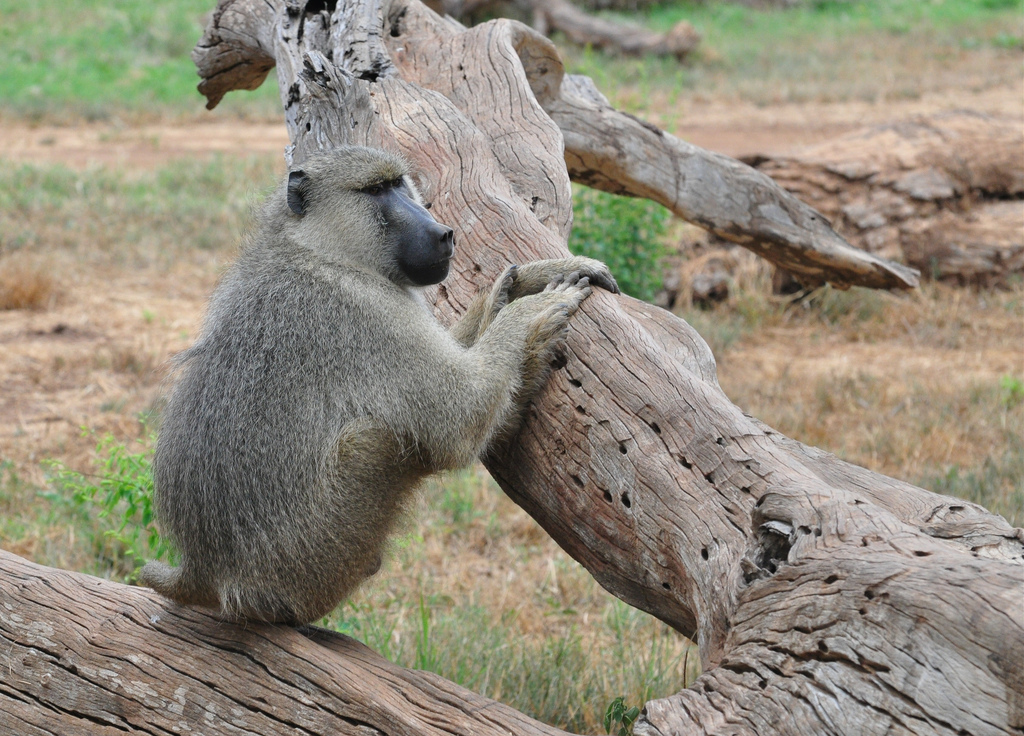
Geez, another housewarming party?! That Forest Troop has GOT to be some sort of a cult or something. (photo: Philippe_Boissel)

In order to analyze the changed behavior more rigorously, the researchers engaged in what’s known as a “focal sampling” process. They systematically recorded the social behavior of individual Forest Troop baboons from 1993 through 1996, and then compared those observations to two other data sets that served as controls – pre-outbreak observations they had made of the Forest Troop from 1979 to 1982, and mid-1990s observations of a different olive baboon troop.

What they found bore out their initial impressions. In particular, the new generation of Forest Troop baboons displayed patterns of dominance and aggression behavior that created less stress for low-ranking males. While the overall number of incidents involving aggression and dominance behavior was comparable to that seen in the control cases, the mix was different. Forest Troop confrontations were now significantly more likely to involve closely-ranked males, as opposed to the control group behavior pattern in which very high ranking males tended to pick on the lowest-ranking ones. This is notable, as confrontations between baboons with large power disparities typically reflect harassment rather than true competition and can be particularly stressful to the lower-ranking subordinates. Moreover, in the post-epidemic Forest Troop, males acted less aggressively towards females, engaged in more social grooming with females, sat in closer proximity to other baboons, and were more likely to have adult females, infants, adolescents, and juveniles as neighbors. Finally, the researchers found that subordinate baboons in the kinder and gentler Forest Troop had much lower levels of glucocorticoids, adrenal hormones secreted in response to stress, than did subordinates in the control groups.

C’mon, Dad, faster! Bumbo and Uncle Phil are waaaay ahead of us!

The researchers next considered how the peaceful new social traditions of the Forest Troop were being passed on to new males joining the troop: were troop members teaching the newcomers to be less aggressive, were new arrivals learning through observation or because they had more opportunities for friendly interactions, or was self-selection causing less aggressive males to gravitate toward this more peaceful troop? The researchers found that new males acted with typical aggression upon arriving at Forest Troop and were greeted with the usual belligerence from other males, but that the Forest Troop females were now uncharacteristically welcoming to the new arrivals, grooming them and otherwise treating them as established residents. Because the females didn’t seem to be engaged in active teaching behavior (they showed the same friendly behavior to even the most aggressive of the newcomers), the researchers concluded that the peaceful Forest Troop cultural traditions were most likely being passed on as newcomers observed more positive interactions with females and had more opportunities to relate non-aggressively themselves.

So, out of ashes of death, a baboon troop forged a new culture and found a way to maintain its peaceful traditions, passing them along to new generations. Makes one think….

_____

ResearchBlogging.orgSapolsky, R., & Share, L. (2004). A Pacific Culture among Wild Baboons: Its Emergence and Transmission PLoS Biology, 2 (4) DOI: 10.1371/journal.pbio.0020106.

Walk This Way! Experienced Female Elephants Show Their Naïve Younger Relatives How to Play the Mating Game

If you’re a female elephant, there’s a right way and a wrong way to play the mating game. To maximize your chances of reproductive success, it’s best to pair up with a dominant bull elephant in musth, a state of heightened arousal in which testosterone courses through the bull’s body, increasing both his sex drive and his aggression. A high-ranking musth elephant not only makes the fittest mate, but he can protect you by scaring off the less desirable younger males who would otherwise chase you around.

An experienced female knows this well, and plays the game accordingly. When she goes into heat – or oestrus – and attracts male suitors through chemicals in her urine, she gives impressive senior bulls the green light by holding her tail high, walking with an exaggerated gait, and exchanging affectionate trunk caresses. Lower-ranking young males don’t fare so well. She actively avoids them and, to the extent they aren’t chased off by her favored partner, she’ll often spurn their advances by running away. (Little known fact: female African elephants can typically outrun male ones.)

It’s not so easy for a young female entering oestrus for the first time. She sometimes runs from the larger musth males, who can weigh more than twice as much as her, and not infrequently ends up consorting with a series of younger, lesser males. This can lead to unfortunate results, especially when you consider that an elephant pregnancy lasts 22 months.

Now, though, there’s evidence that experienced females may help their younger relatives in sorting through the confusing tangle of elephant sexual dynamics. These helpful older elephants – sisters, aunts, mothers, and matriarchs – appear to simulate oestrus in order to show their innocent family members how to act, enabling them to avoid the pitfalls of poor mating choices.

If I said you had a beautiful trunk, would you hold it against me? (photo: WildlifeDirect, Dzanga Forest Elephants)

After hearing anecdotal accounts of this behavior, a team led by Lucy Bates of the University of St. Andrews decided to dig deeper by taking advantage of an invaluable resource – a comprehensive multi-decade database cataloging the daily life activities of 2,200 Amboseli elephants compiled by Cynthia Moss, Joyce Poole, and other researchers as part of the Amboseli Elephant Research Project (AERP).

Bates and her colleagues systematically combed through 28 years of detailed AERP records and located all occasions on which an observer had concluded that an identifiable elephant was in oestrus (based on postural and behavioral changes in females, interactions with males, etc.). In total, they found descriptions of 999 oestrus events, slightly less than 10% of which (98 events) recorded two or more members of the same elephant family displaying simultaneous oestrus behavior.

Next, the researchers cross-referenced these accounts with AERP demographic records to find any that must have been “false” oestrus events, which they defined as oestrus-like behavior by a female who was either already pregnant, in a state of lactation-induced infertility, or senescent (which they deemed to be the case if she was over 50 years old, had not given birth to any calves during the prior five years, and had no subsequent calves).

They discovered that, while false oestrus behavior was relatively rare (occurring only 19 times and representing only about 2% of all recorded oestrus events), its timing was fascinating. Very often, it occurred just when a young relative was coming into oestrus for the first time.

Even though simultaneous oestrus behavior had been recorded less than 10% of the time, over half of the false oestrus events (10/19) clearly occurred at the same time as the true oestrus of a young female family member who had never given birth. Further, subsequent birth records confirmed that on four additional occasions a false oestrus event occurred during the month that a young relative conceived her first calf (that is, the young female must have been in oestrus at the time, even though it wasn’t specifically called out in the AERP database). Finally, one of the false oestrus events occurred simultaneously with the genuine oestrus of a female relative who had given birth before. Thus, the large majority of the false oestrus events – 15 of 19 – coincided with true oestrus events, in most cases, the first oestrus of a young relative. (Moreover, note that the balance of the false oestrus events could also have coincided with true ones if, as in the four cases described above, the true oestrus event simply had not been observed or recorded in the AERP database.)

The researchers then examined various hypotheses that might explain the false oestrus behavior:

  • That false oestrus merely results from hormonal changes and has no functional purpose;
  • That it somehow induces sexual receptivity in the simulating female, thereby increasing her own chances of successfully reproducing;
  • That it indirectly benefits the simulating female by providing a young family member with increased access to suitable males (this type of indirect benefit is known as an inclusive fitness benefit); or
  • That it indirectly benefits the simulating female by encouraging a confused younger relative to engage in more suitable oestrus behavior (another potential example of inclusive fitness).

They quickly rejected the all but the final hypothesis. For one, hormonal changes couldn’t adequately explain either the observed patterns (false oestrus occurred in both pregnant and non-pregnant females, as well as during all stages of pregnancy) or the higher-than-expected coincidence of false oestrus with the genuine oestrus events of inexperienced relatives. Second, it was clear that the simulating elephants weren’t improving their own reproductive success: in 14 of 19 cases the simulating the female was already pregnant, and in four others she was senescent. Third, AERP records revealed that false oestrus behavior had no impact on the number of available males, the relative percentage of males who were in musth, or the amount of sexual activity engaged in by inexperienced female.

Ultimately, the researchers concluded that:

Further data is required to confirm or reject the hypothesis that this behaviour functions to teach the young, naïve females, but we suggest that it remains the only viable possibility based on the current analyses.

In particular, they noted that additional research and data collection was necessary to explain the instances in which false oestrus didn’t appear to coincide with an inexperienced relative’s oestrus as well as to support the notion that inexperienced females were able to correct substandard mating behavior after they were shown what to do by their older relatives.

In the meantime, though, you’d be well advised to stay away from those frivolous young guys and find yourself a dashing older bull who knows his way around the herd.

_____

ResearchBlogging.orgBates, L., Handford, R., Lee, P., Njiraini, N., Poole, J., Sayialel, K., Sayialel, S., Moss, C., & Byrne, R. (2010). Why Do African Elephants (Loxodonta africana) Simulate Oestrus? An Analysis of Longitudinal Data PLoS ONE, 5 (4) DOI: 10.1371/journal.pone.0010052.

An Uplifting Dolphin Story. Literally.

I’ve always found friendly interactions between animals of different species to be oddly reassuring. After all, the world can’t be all that bad a place if two animals, separated by differing genetic backgrounds and behavioral imperatives, can find a way to reach across the biological divide and share something, something joyful and positive.

Because of this, I’m an absolute sucker for all of those YouTube videos of cats curling up with mice, horses who befriend sheep, elephants and dogs who are inseparable, and the like. You know the ones I mean.

Many times, though, these are artificial pairings that spring up after we humans have altered the environment, habituating or even confining the animals with one another. While these human-influenced relationships can be incredibly heartwarming, it somehow seems even more magical when animals forge connections across species boundaries in the wild, in their native habitats and without any human intervention.

With that background, I’d like to introduce a paper published last year in the journal Aquatic Mammals1, which reports on two separate playful and – as you’ll see – uplifting encounters between bottlenose dolphins (Tursiops truncatus) and humpback whales (Megaptera novaeangliae).

The first took place on a January afternoon off the northwest coast of Kauai, when a group of eight bottlenose dolphins met up with a pair of humpback whales. Two of the dolphins – apparently adults – approached one of the whales, first appearing to surf the pressure wave created by the whale’s head as it swam, and later taking turns lying perpendicularly across the whale’s rostrum when it surfaced to breathe. Then, while one of the dolphins lay balanced over the end of its rostrum, the whale stopped and slowly lifted the dolphin high into the air. The dolphin maintained an arched position and made no effort to escape, allowing the whale to continue lifting until it was nearly vertical in the water, at which point the dolphin slid down the whale’s rostrum, dove into the water, and porpoised back to its fellow dolphins.

Here’s a color photo of the dolphin just about to go whale-sliding:

Look Ma, No Hands! (photo credit: L. Mazzuca)

And here’s a black and white series of shots that captures the full adventure sequence:

The second encounter also occurred on a January afternoon, this time off the northwest coast of Maui, when an adult female bottlenose dolphin swam up to a mother humpback whale and her calf. After diving underwater, the dolphin and mother whale resurfaced with the dolphin resting across the mother whale’s rostrum. The mother then proceeded to lift the dolphin a total of six times over 8.5 minutes, with the dolphin either lying on her stomach or right side during the lifts, which varied in length from four to 45 seconds. Again, the dolphin made no attempt to escape and held her position in such a way as to facilitate the whale’s lifting.

Here’s a sequence of photos showing this second duo demonstrating the proper technique for lifting a relaxed-looking dolphin:

The authors of the Aquatic Mammals paper considered alternate explanations for these interactions, including whether they represented an aggressive whale response to an antagonistic dolphin approach, whether the whales were demonstrating concern regarding perceived distress in the dolphins, or whether the cetaceans were simply playing together. They found the first two hypotheses to be unlikely – among other things, the interactions were too cooperative and relaxed in pace to be aggressive, and the dolphins were in good health and showed no evidence of distress. In the end, while the authors didn’t rule out the possibility that maternal instinct was involved in the whales’ lifting behavior, they concluded that the best explanation was that these were simply instances of interspecies play between the bottlenose dolphins and humpback whales.

Further, these bouts of play between dolphins and whales may not be all that uncommon, as back within the friendly confines of YouTube I was able to locate a video documenting another episode in which a bottlenose dolphin went for a ride on the rostrum of a humpback whale:

Play may serve a number of important purposes – for example, it may provide an avenue for intelligent, social animals like dolphins and whales to experiment with their surroundings, hone their physical skills and learn how to interact collaboratively with others. But aside from any practical evolutionary significance, I like to think of these encounters as illustrating how animals can, on occasion, take a few minutes away from the serious business of survival to share some pure joy and wonder with a fellow being, even a fellow being of a different species.

So, all of this is comforting. If dolphins and whales (and other animals who form interspecies bonds) can find a way to communicate playfulness with each other and to share experiences without any kind of a common language, perhaps we humans can do a bit better ourselves. Maybe some of the divides we see today – political discord, religious conflict, international posturing, cultural and racial inequities – aren’t so unbridgeable after all. Perhaps all we need to do is to remember an uplifting dolphin story or two.

_____

ResearchBlogging.org1Deakos, M., Branstetter, B., Mazzuca, L., Fertl, D., & Mobley, J. (2010). Two Unusual Interactions Between a Bottlenose Dolphin (Tursiops truncatus) and a Humpback Whale (Megaptera novaeangliae) in Hawaiian Waters Aquatic Mammals, 36 (2), 121-128 DOI: 10.1578/AM.36.2.2010.121.

Setting His Own Dinner Table: Spontaneous Tool Use by a Dingo

The name tags kept disappearing, and the staff at Melbourne’s Dingo Discovery and Research Centre was mystified. After romping around the grounds of the dingo sanctuary, Sterling, an 18 month old sub adult male, and his two canine companions spent time in an indoor enclosure that had a name tag posted on the outside of the steel mesh wall. The tag was positioned 1.7 meters above the ground, well out of dingo-reach. Still, it kept vanishing.

As reported in a paper published online last week in Behavioural Processes,1 the caretakers decided that it was time solve the mystery. First, they hung a small plastic envelope filled with food near the name tag and watched to see what the dingoes would do. The dingoes were having none of that, however – as long as observers were around, the dingoes studiously ignored both the name tag and the envelope of food. Since the direct approach clearly wouldn’t work, the staff resorted to sneakiness, rigging up a video camera and then leaving the dingoes to their own devices.

Success! When the staff returned to the enclosure, they found that the food was gone and, more importantly, that the videotape reflected perhaps the first documented instance of tool use by a member of the Canid family. As described in the Behavioural Processes paper:

Big deal, Lassie; when Timmy fell down *my* well, I hoisted him out using a system of pulleys. (Sterling at Dingo Discovery and Research Centre, photo by Dingo Lyn)

[A]fter several unsuccessful attempts at jumping for the envelope, Sterling “solved” the task by first moving and then jumping up onto a trestle table (1.2 m × 0.6 m × 0.73 m) which allowed him to gain the additional height necessary to reach the food item. To move the table, Sterling clamped his mouth onto the strut between the legs of the table. He then walked backwards, dragging the table approximately 2 m, until it appeared that either his back leg or tail touched the enclosure mesh. He then jumped onto the table, but as he was still at least a body-length away from the envelope, he had to span the gap between the table and the enclosure mesh by propping his front paws onto the mesh gradually moving them towards the envelope. At full stretch, he reached the envelope on his second attempt.

While this account of Sterling’s actions may sound impressive, it’s even more striking when seen on video:

Bradley Smith of the University of South Australia and his colleagues noted in their paper that Sterling’s behavior appeared to be spontaneous – he had never been trained or encouraged to position the table in order to reach food (or name tags) – but they cautioned that they had to rely on information provided by the sanctuary’s staff regarding Sterling’s (lack of) relevant training in the past.

No problem, just bring me a socket wrench, a crow bar and three sticks of gum... (Sterling at Dingo Discovery and Research Centre, photo by Dingo Lyn)

Sterling, for his part, was no one-hit wonder. According to sanctuary staff, from an early age Sterling was adept at manipulating his environment to serve his purposes. For example, during one breeding season he used his front paws to roll a barrel to a wall, jumped up on the barrel, scrambled over the wall, and approached a female dingo in another area of the sanctuary. Also, the staff and research team later videotaped separate occasions in which Sterling used his mouth to drag a plastic dog kennel to differing locations around his enclosure, allowing him to stand on the kennel and peer over walls into neighboring dingo enclosures.

Thus, while the researchers couldn’t exclude the possibility that Sterling’s problem-solving abilities were the result of observational learning or that they had somehow been reinforced when he was younger, they rightly recognized that he appeared to be engaging in “high order behaviour” in using tools within his environment to solve complex problems. (Indeed, on the face of it, Sterling’s problem-solving is quite very reminiscent of Kandula the elephant’s insightful use of a box within his yard to solve an out-of-reach food challenge.)

So, now that you know what canines are capable of, please feel free to ask your dog Barkley when he’s going to get around to assembling that futon you bought at Ikea. No more excuses.

_____

ResearchBlogging.org1Smith, B., Appleby, R., & Litchfield, C. (2011). Spontaneous tool-use: An observation of a dingo (Canis dingo) using a table to access an out-of-reach food reward Behavioural Processes DOI: 10.1016/j.beproc.2011.11.004.

2As we’ve noted in previous posts (see, for example, the post on the poison rat and the tuskfish tool post), scientific authorities have defined the concept of “tool use” in various ways. In the Beck and Shumaker treatise discussed in the poison rat post, the authors describe a couple of anecdotal instances that may qualify as canid tool use under their broad definition, including an account of a wolf mother who used meat as a “baiting” and “enticing” tool to distract her young pup. Fox, M. (1971). Possible Examples of High-Order Behavior in Wolves Journal of Mammalogy, 52 (3) DOI: 10.2307/1378613.