Zeroing In On Parrot Math Abilities

It may seem surprising, but the concept of “zero” is actually a relatively recent mathematical innovation. Indeed, the first rudimentary use of a zero-like notation didn’t appear until around 300 BC, when the Babylonians began using a special placeholder symbol to designate the absence of another value in their base-sixty number system. While revolutionary in its own right, the Babylonian null placeholder was still rather limited (for example, it couldn’t be used alone and never appeared at the end of a number), and another millennium passed before gifted Indian mathematicians and astronomers introduced a fully functional “true zero” as part of a formalized system of arithmetic operations. Some 1,500 years later, with this important mathematical foundation finally in place, Apple launched the iPhone on the AT&T wireless network.

Are there any parallels in the animal world, any similarly gifted nonhuman mathematicians that have innovated with the concept of zero?

The answer seems to be yes: Alex, the male African Grey Parrot of book and movie fame (Alex & Me), may go down in history as the parrot equivalent of Albert Einstein, revolutionizing parrot mathematics with his insight into concepts of nothingness.
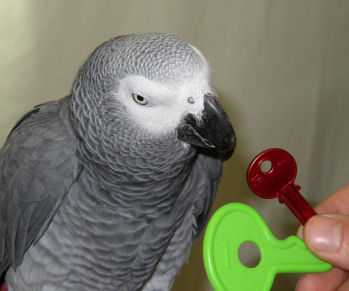
How many crackers do I see? None! (image: The Alex Foundation)

It was in late 2003, early 2004 that Alex appears to have had his great breakthrough regarding the mathematical usefulness of zero-like concepts. At that time, Irene Pepperberg and Jesse Gordon of Brandeis University, who had been working with Alex over an extended period on a variety of cognitive and communicative studies, decided to conduct some experiments to explore the extent of his numerical competence.

Alex already was adept at tests requiring him to identify numbers of objects – he knew the English words for one through six, and could provide accurate verbal responses to questions about, for instance, how many green blocks were included in a mixed array of blue, red and green blocks and balls. Pepperberg and Gordon now wanted to see whether Alex really understood the numbers he was providing and could grasp the interchangeability of numerical questions.

To do so, they flipped things around: rather than asking Alex to provide the number of objects in particular groupings as he had in prior experiments, they went in the other direction by asking him to indicate which object groups were associated with a particular number. That is, they presented Alex with a tray of objects of various materials, colors and shapes (for example, six green plastic spoons, four yellow tops and three orange wooden sticks), and asked him questions such as “What color six?” and “What toy four?” Alex’s task was to look at the objects on the tray and then respond correctly (in this case, with “green” based on the six green spoons and “top” based on the four yellow tops).

(I know, this all sounds a bit like Jeopardy: “Please be sure to phrase your answer in the form of a question…”)

Perhaps not surprisingly, Alex aced the test, responding correctly to this new battery of questions over 80% of the time. More significant, though, is how Alex – apparently bored with the questioning – spontaneously extended the scope of the experiment:

On the 10th trial within the first dozen, Alex was asked “What color 3?” to a set of two, three, and six objects. He replied “five”; the questioner asked him twice more and each time he replied “five.” The questioner, not attending to the tray, finally said “OK, Alex, tell me, what color 5?” Alex immediately responded “none.”

Now, Alex had previously been trained to use the word “none” in a different context – comparing objects for similarity or difference (for example, to respond to a question about which of two identically-sized objects was bigger) – but he had never been taught to use “none” to describe a quantity that was not present. Fascinated, Pepperberg and Gordon randomly interspersed six more “none trials” into the ongoing experiment. It turned out that Alex’s response was no fluke – he gave the correct “none” response in five out of six of these trials, an accuracy rate of 83.3%.

Here’s a brief video in which Pepperberg describes the experiment and Alex’s unexpected use of the “none” concept:

Thus, it appears that Alex spontaneously used “none” in a zero-like manner to label a null set and designate an absence of objects. As the researchers summarized it, “the notion of none, even if already associated with absence of similarity and difference (and lack of size difference), is abstract and relies on violation of an expectation of presence; that Alex transferred the notion from other domains to quantity, without training or prompting by humans, was unexpected.”

While Alex’s use of “none” may not be as full and robust as the true zero concept that we use today, it nonetheless (no pun intended) is quite impressive. Moreover, Alex’s insight may prove to be quite practical, with the parrot concept of “none” providing helpful guidance as we attempt to answer some of the more pressing questions of our time, including:

_____

ResearchBlogging.orgPepperberg, I., & Gordon, J. (2005). Number Comprehension by a Grey Parrot (Psittacus erithacus), Including a Zero-Like Concept. Journal of Comparative Psychology, 119 (2), 197-209 DOI: 10.1037/0735-7036.119.2.197.

It’s Not That Funny, the Chimp Is Just Being Polite

“Ha ha ha,” politely hoots the chimpanzee, not exactly rolling on the floor. He’s not laughing spontaneously or for very long, but he does want to encourage his playmate to keep up the antics.

Continuing on in the spirit of last week’s post on the rodenty laughter of tickled rats, today’s post features a recent study on social laughing in chimpanzees.

As we all know quite well from experience, human laughter is a many-faceted thing. Sure, we sometimes laugh spontaneously and joyously (this is known as Duchenne laughter), but we also use our laughter as a multipurpose social tool, enabling us to establish rapport with social partners, to announce that we are nonthreatening and open to further communication, to alleviate tension and break barriers when meeting an unfamiliar face, and even to exclude others by demonstrating scorn or derision. In short, laughter sends a wide range of communicative signals, and our mastery over its many varieties lies close to the core of what’s sometimes referred to as emotional intelligence – the sophisticated way in which we assess, understand and navigate social situations.

Well, do any other animals manage their laughter for social reasons, or is nonhuman laughter inevitably spontaneous and reactive, like the high-pitched chirping of tickled rats? (Not that this would be a bad thing, just ask the rats….)

Marina Davila-Ross and her co-researchers from the University of Portsmouth decided to test some chimpanzees to find out. They studied 59 male and female chimpanzees of all ages living in four separate colonies at the Chimfunshi sanctuary in Zambia – two smaller colonies that had formed within the past five years, and two larger ones that had been together at least 14 years. In general, the chimps in the colonies that had been together longer belonged to more established families and had grown up with more opportunities to play with others in a familiar social environment.

Did you see the look on Mr. Mookimbo’s face when he bit into the “cake”? (photo credit: David Eppstein)

First, the researchers videotaped almost 500 one-on-one play sessions, documenting what the chimps did and when they laughed. The researchers recorded spontaneous laughter as well as laugh replications (laughter that followed within five seconds after a playmate’s laughter), and further noted whether the laugh replications occurred during the first second (rapid laugh replication) or within the next four seconds (delayed laugh replication).

The research team soon discovered that the chimps’ spontaneous laughter was substantially different than their laugh replications: the laugh replications were much shorter, consisting of significantly fewer calls per laugh series. Among other things, the researchers also found that:

  • Chimps in the more recently-formed colonies replicated the laughter of their playmates more frequently than did the chimps in longer-established colonies, even though the aggregate amount of all laughter in each of the colonies was relatively comparable.
  • Infants generally engaged only in spontaneous laughter, with little or no laugh replication.
  • Play bouts lasted significantly longer when they were accompanied by laugh replications than when they weren’t.
  • Laugh replications peaked at two discrete points, first at about .7 to .8 seconds after the initial laugh, and then again between 2 and 3 seconds after the initial laugh.

Next, the researchers tried to verify whether laugh replications were specifically triggered by a playmate’s laughter, and not just coincidentally associated with it. They combed through their previously-recorded video footage and, for specific chimps and their playmates, found matching play scenes that generally lined up very closely in terms of specific behaviors (chasing, tickling, grabbing, wrestling, gnawing, hitting, jumping, game playing, etc.), but that differed in one important respect – in one scene, the chimp’s playmate engaged in a potentially-triggering bout of laughter; in the other scene, it did not. When the researchers reviewed these paired scenes, they found that a chimp was significantly more likely to laugh in those scenes in which the other chimp laughed first, suggesting strongly that replicated laughter really was triggered by the playmate’s laughter as opposed to any other aspect of the chimps’ play behavior.

Well, one thing’s for sure, they’re not going to trust us with *next year’s* holiday decorations… (photo credit: Christa Saayman)

Based on their findings, the researchers concluded that chimps laugh in response to the laughter of their playmates, that this laughter differs in acoustic form and timing from their spontaneous laughter, and that the purpose of their non-spontaneous laughter appears to be to prolong social play, promoting group cohesion and perhaps providing the chimps with important social advantages.

In support of these conclusions, the researchers also observed that the lack of laughter replication in infant chimps suggests that socially managed laughter is a skill that chimps learn as they mature. Further, they hypothesized that the chimps in the newer colonies may have engaged in more replicated social laughter because they were living in a less predictable social environment and may have had a greater need to manage laughter in order to establish social cohesion.

So, next time you’re at a party with a group of laughing chimpanzees (don’t think I don’t know you, AnimalWise readers), listen very closely to the rising levels of laughter around you. While you might be tempted to believe that you’re hanging out with a particularly hilarious crowd, the truth may be that your fellow party goers are simply adept at using laughter as a social lubricant. Let the good times roll!

_____

ResearchBlogging.orgDavila-Ross, M., Allcock, B., Thomas, C., & Bard, K. (2011). Aping expressions? Chimpanzees produce distinct laugh types when responding to laughter of others. Emotion, 11 (5), 1013-1020 DOI: 10.1037/a0022594.

The Ticklish Laughter of Rats

Let’s go tickle some rats.” With those epic words, neuroscientist Jaak Panksepp and his undergraduate assistant, Jeff Burgdorf, went into their Bowling Green State University lab to engage in the hard work of science.

Panksepp, who had been studying play behavior in young human children as well as 50-kHz ultrasonic chirping noises made by juvenile rats during rough-and-tumble play, had just put two and two together: “I had the ‘insight’ (perhaps delusion) that our 50 kHz chirping response in playing rats might have some ancestral relationship to human laughter.1

The rest has been history, and today Panksepp is undoubtedly the world’s foremost authority on rodent tickling:

As they progressed with their research, Panksepp and his colleagues found that many of their rats seemed irresistibly drawn to tickling, chasing after the ticklers and making substantially more play chirps while being tickled than during any other behavior. But the researchers weren’t content with anecdotal observations, and over the course of several years and a number of experiments, they systematically documented a dozen separate lines of evidence suggesting that the rats’ tickle chirping corresponded behaviorally to playful laughter in young human children.2

No, I went "chirp, chirp, chirp." If I'd been laughing, it would have been "chirp, chirp, chirp."

They compiled data establishing, among other things, that certain areas of the body are particularly ticklish (the nape of the neck, for you do-it-yourselfers), that the most playful rats tend to be the most ticklish, that rats can become conditioned to chirp simply in anticipation of being tickled, that tickle response rates decline after adolescence, that young rats preferentially spend time with older ones who chirp more frequently, that the tickle response appears to generate social bonding, that chirping decreases in the presence of negative stimuli (such as the scent of a cat), that rats will run mazes and press levers to get tickled, etc. Based on their research and observations, Panksepp and his fellow researchers hypothesized that rats, when being tickled or engaging in other playful activities, experience social joy that they vocalize through 50 kHz chirping, a primordial form of laughter that is evolutionarily related to joyful social laughter in young human children.

Does it look like my name is Elmo?

It’s safe to say that the neuroscientific community did not exactly rush to embrace this hypothesis. Behavioral neuroscience can be a particularly conservative and skeptical field, one that has traditionally been extremely wary of any theorizing about emotions controlling neural processes or behavior in animals. Since subjective experiences cannot, after all, be measured directly, it has been considered far more appropriate to those functional brain activities and processes that can be scanned and measured objectively, and to simply deny or ignore the possibility that animals experience complex emotional states such as joy, at least in the context of scientific research. As Panksepp put it:

Of course, it was hard to publish this kind of work, and it was ironic that the publication of our initial manuscript was impeded by prominent emotion researchers, some of whom take pains to deny that we can ever know whether animals have any emotional feelings.3

Hahaha, we've had our little fun now, haven't we? If you tickle me again, I'll pee in your coffee.

Fortunately, time and scientific progress have been on Panksepp’s side. We have identified an increasing number of common underlying structures and processes (homologies) in the brains of humans and other mammals and, as brain scanning technologies have become more sophisticated, we have gained greater insight into neural activities triggered in connection with particular emotional experiences. While the ability to cognitively “get a joke” may depend on our incredibly advanced human neocortex, we now believe that much of the foundational brain circuitry relating to laughter, mirth, social joy, social play and emotional processing lies deep within subcortical regions, where our brains are much more similar to those of other animals.

At this point, Panksepp and his colleagues recognize that they have not definitively proven their hypothesis, but their view is essentially that they have made a reasonable case that fits their data and that hasn’t been disproved:

Until someone can offer us some data that falsifies our hypothesis, we believe our theoretical approach better reveals the true nature of the underlying processes than any intellectual scheme that simply constrains itself simply to the accurate description of the environmental and neural control of behavioral acts.4

Even acknowledging the understandable caution of neuroscientists and the obvious difficulty in drawing scientific conclusions about the subjective experiences of animals, it does seem entirely plausible (and not overly surprising) that social animals such as rats would enjoy playful romping and tickling, and that they might vocalize their pleasure in a way that was somewhat akin to basic human laughter. In fact, we hope and fully expect that, as our knowledge of comparative brain structure and function grows over time, we will see more and more studies that show clear linkages between the minds and brains of humans and other animals.

_____

ResearchBlogging.org1Panksepp, J. (2007). Neuroevolutionary sources of laughter and social joy: Modeling primal human laughter in laboratory rats Behavioural Brain Research, 182 (2), 231-244 DOI: 10.1016/j.bbr.2007.02.015.

2Panksepp, J., & Burgdorf, J. (2003) “Laughing” rats and the evolutionary antecedents of human joy?. Physiology & Behavior, 79(3), 533-547. DOI: Panksepp, J., & Burgdorf, J. (2003). “Laughing” rats and the evolutionary antecedents of human joy? Physiology & Behavior, 79 (3), 533-547 DOI: 10.1016/S0031-9384(03)00159-8.

3Panksepp & Burgdorf (2003).

4Panksepp (2007).

A Yawning Divide? Contagious Yawning and Empathy in Animals

A group of red-footed tortoises ran away (rather slowly) with the 2011 Ig Nobel Prize in physiology1, bringing to center stage the potential link between contagious yawning and empathy in animals. While the Ig Nobels are a tongue-in-cheek spoof of the Nobel Prizes, their purpose is not frivolous – they “honor achievements that first make people laugh, and then make them think. The prizes are intended to celebrate the unusual, honor the imaginative — and spur people’s interest in science, medicine, and technology.” Here’s the story of the tortoises’ claim to fame and what we know about contagious yawning in animals.

Tortoise yawning? I don’t think so!

It turns out that the underlying cause of contagious yawning has been something of a puzzle – why is it that when you see someone else yawn (or even hear a yawn or just think about yawning), you sometimes are overcome with the urge to yawn yourself? The most common hypotheses are that contagious yawning results either from empathy or from non-conscious social mimicry, the tendency to adopt a social partner’s postures, gestures and mannerisms. An alternative hypothesis, however, is that it may simply reflect a fixed action pattern, an innate or instinctual response to a stimulus (a triggering yawn).

No, really, go on - I'm listening... (photo: Peter Baumber)

And that’s where the red-footed tortoises lumber into the picture. Lead researcher Anna Wilkinson and her colleagues figured the tortoises would offer a good way of testing the fixed action pattern hypothesis, since they are known to yawn and respond to social stimuli, but are not believed to exhibit empathy or engage in non-conscious social mimicry.

The researchers worked very hard to induce contagious tortoise yawning, spending six months training one of them (Alexander, if you’re curious) to yawn whenever he saw a red square-shaped symbol, and then devising a series of tests to see whether six “observer” tortoises would yawn after seeing Alexander yawn. Initially, the observers were presented with three scenarios: one in which they watched Alexander giving one of his patented yawns, another in which they watched a non-yawning tortoise (Alexander?), and a third in which they simply viewed Alexander’s red square. A second experiment mirrored the first, except this time the observers watched Alexander yawn multiple times. Finally, they went to the movies, seeing clips of real tortoise yawns, fake yawns and an empty background.

And the results? Nothing, nada, zilch. The tortoises simply didn’t yawn more frequently after seeing another tortoise yawn; no contagious yawning whatsoever. This spectacular display of non-yawning in tortoises led the researchers to “suggest that contagious yawning is not simply the result of a fixed action pattern and releaser stimulus …. We suggest that contagious yawning may be controlled through social processes such as nonconscious mimicry or empathy….” Naturally, international acclaim ensued.

Apes and Monkeys and Dogs, Oh My!

So, which animals do demonstrate contagious yawning? Well, as with other cognitive realms, our views of contagious yawning have followed “AnimalWise’s Rule”: first we believed it to be an exclusively human behavior, then we observed it in chimpanzees, then we saw it in monkeys, next in dogs, now … hmm … Taste it, fur-face, I have opposable thumbs!  Ok, I lied, that’s not a real rule; I just made it up.

Here’s a run-down on what we actually know about contagious yawning in non-humans:

Chimpanzees

The phenomenon was first demonstrated in chimpanzees in 2004 when a research team led by James Anderson of the University of Stirling reported2 on a small study in which six adult female chimps watched video scenes of other chimps who were either yawning naturally or, alternatively, displaying open-mouthed facial expressions that weren’t yawns. Two of the observers (33%) yawned significantly more often in response to the yawn videos and none of them yawned more frequently in response to the open-mouth control videos, a response rate only slightly lower than that in humans watching comparable videos. In 2009, Matthew Campbell and colleagues from the Yerkes National Primate Research Center (YNPRC) expanded on these findings, reporting3 that, much like humans responding to on-screen yawns by Pixar characters, a group of 24 chimps yawned significantly more often after watching 3D computer animations of yawning chimps than after watching animations of chimps displaying non-yawn mouth movements. Finally, Matthew Campbell and Frans de Waal of the YNPRC reported4 this year on an experiment lending empirical support to the hypothesis that contagious yawning stems from empathy. Campbell and de Waal found that, consistent with studies showing that humans demonstrate greater empathy towards others they view as being similar, chimps yawned significantly more frequently in response to videos of familiar chimps yawning than they did to either videos of unfamiliar chimps yawning or videos of chimps (regardless of familiarity) who were at rest.

Monkeys

The first study supporting contagious yawning in non-ape primates was published5 in 2006 by University of Stirling researchers Annika Paukner and James Anderson, who had 22 stumptail macaques watch video clips of other macaques either yawning or making non-yawn facial movements. Although the macaques yawned significantly more in response to yawn tapes than to non-yawn tapes, the researchers noted that the macaques engaged in more self-directed scratching (a tension-relieving behavior) while watching the yawn tapes, making it difficult to differentiate between actual contagious yawning and the release of stress perhaps brought on by the yawn tapes. The case for non-hominid contagious yawning was bolstered in 2009, though, when Elisabetta Palagi of Pisa University and her colleagues published6 a study in which they recorded and reviewed over 3,200 baboon yawning displays (all occurring in the absence of stressful events or behavior). They not only found clear evidence of contagious yawning among adult baboons, but also discovered that females (but not males) tended to match the type of yawning display (baboons make different facial expressions when yawning) that had triggered their own yawn, and that the degree of contagiousness correlated with social closeness, thus supporting an empathy-basis for yawn contagion and anticipating the results of 2011 chimpanzee experiment described above.

Dogs

Lastly, in 2008 Ramiro Joly-Macheroni and colleagues from the University of London reported7 on an experimental first on multiple fronts: yawn contagion in a non-primate species and the first demonstration of possible contagious yawning across different species. In their study, 29 dogs observed an unfamiliar human either yawning or making non-yawning mouth movements, with 21 dogs yawning in response to the yawning human and not one yawning in response to the human who displayed the non-yawning control behavior.

Future Directions

I know that if the Internet were allowed to vote, researchers would spend much of their waking hours considering YouTube videos of impossibly cute kittens yawning, but I want to take this opportunity to call for a full and serious investigation into the concerning link between contagious duck wing flapping and odd French Canadian music:

_____

ResearchBlogging.org1Wilkinson, A., Sebanz, N., Mandl, I., & Huber, L. (2011). No evidence of contagious yawning in the red-footed tortoise Geochelone carbonaria. Current Zoology, 57(4), 477-484.

2Anderson, J., Myowa-Yamakoshi, M., & Matsuzawa, T. (2004). Contagious yawning in chimpanzees Proceedings of the Royal Society B: Biological Sciences, 271 (Suppl_6) DOI: 10.1098/rsbl.2004.0224.

3Campbell, M., Carter, J., Proctor, D., Eisenberg, M., & de Waal, F. (2009). Computer animations stimulate contagious yawning in chimpanzees Proceedings of the Royal Society B: Biological Sciences, 276 (1676), 4255-4259 DOI: 10.1098/rspb.2009.1087.

4Campbell, M., & de Waal, F. (2011). Ingroup-Outgroup Bias in Contagious Yawning by Chimpanzees Supports Link to Empathy PLoS ONE, 6 (4) DOI: 10.1371/journal.pone.0018283.

5Paukner, A., & Anderson, J. (2006). Video-induced yawning in stumptail macaques (Macaca arctoides) Biology Letters, 2 (1), 36-38 DOI: 10.1098/rsbl.2005.0411.

6Palagi, E., Leone, A., Mancini, G., & Ferrari, P. (2009). Contagious yawning in gelada baboons as a possible expression of empathy Proceedings of the National Academy of Sciences, 106 (46), 19262-19267 DOI: 10.1073/pnas.0910891106.

7Joly-Mascheroni, R., Senju, A., & Shepherd, A. (2008). Dogs catch human yawns Biology Letters, 4 (5), 446-448 DOI: 10.1098/rsbl.2008.0333.