Recently, the blackspot tuskfish (Choerodon schoenleinii) became a media sensation when it was captured in photos using a rock as tool to open a clam. Apparently not happy with the print media attention afforded to its relative, the orange-dotted tuskfish (Choerodon anchoago) has taken the behavior to the movies, digging up a clam with its pectoral fin, swimming about five meters with it, and then crushing it open using a rock as an anvil:
…
As reported in the latest issue of Coral Reefs, a diver off the coast of Palau observed the orange-dotted tuskfish using a rock as a tool on three separate occasions, capturing the above footage on the final instance. The paper notes that three separate genera of wrasses (the Choerodon that have been in the news lately, as well as the Halichoeres and Thalassoma) have now been seen using similar sideways head movements to slam bivalves against rock anvils, suggesting that this may be a “deep-seated behavioral trait” in wrasses and, potentially, other groups of fishes.
_____
Bernardi, G. (2011). The use of tools by wrasses (Labridae) Coral Reefs DOI: 10.1007/s00338-011-0823-6
In our man-made world, it can feel like everything is converging all at once. Indistinguishable glass skyscrapers sprout up in cities all over the globe, near identical car models vent carbon dioxide into the air on different continents, and people around the world see their waistbands expand as they gulp down the same McFood. Global economies are more connected than ever, with natural disasters in Japan, sovereign debt issues in Europe, and rumors of Wall Street misdeeds shaking worldwide markets within minutes. Even the social media that deluge us with information seem like they’re growing more and more alike, as we now drown in unending streams of look-alike feeds, postings, messages and links from Twitter, Facebook, Google+ and others.
You may wonder whether the forces of convergence are a recent phenomenon, a product of human technology, or whether they may have deeper roots in the natural world. In fact, convergence can and does occur in the realm of biological evolution, albeit at a more comfortable pace. For example, “convergent evolution” occurs when different species independently evolve similar solutions to comparable evolutionary pressures. A classic example of this is the development of wings and the ability to fly by birds, bats and pterosaurs:
Diagram of wing morphology and/or and comparative network hub structure of Twitter, Facebook and Google+ (image credit: National Center for Science Education)
Consider also the independent evolution of sleek, torpedo-shaped bodies by fish, cetaceans and ichthyosaurs:
Sleek ocean swimmers (image credit: All About Reptiles)
Closer to home, scientists at the Max Planck Institute for Evolutionary Anthropology have concluded that we may be undergoing a process of cognitive convergent evolution with dogs based on our social relationships over thousands of years with these “best friends” of ours. In a paper published in Trends in Cognitive Sciences, Brian Hare and Michael Tomasello reviewed a large number of studies focused on canine, human, and non-human primate social and communicative skills and reached some interesting conclusions.
Proof of convergent canine-human evolution (source unknown)
They began their analysis by focusing on research showing how well domestic dogs do at interpreting human social and communicative behavior. For example, dogs excel at tests in which experimenters hide food in one of several opaque containers and then signal where it has been hidden by pointing, gazing, bowing or nodding, or placing markers in front of the target location. The dogs easily interpret this type of cue, passing tests such as these on the first attempt and performing correctly even when humans try to trick them by walking towards the wrong container while pointing in the opposite direction to the correct container.
Also, studies have shown that dogs are aware of what humans can see. For instance, if a human turns around during a game of fetch, the dog will almost invariably bring the ball back around the human and drop the ball in front of his face. Similarly, dogs have shown that they prefer to beg for food from humans whose eyes are visible than from ones whose eyes are covered with a blindfold or bucket, but are more likely to approach forbidden food when a human’s eyes are closed.
Indeed, dogs actually consistently outperform chimpanzees and other primates at these types of skills, even though, in areas of non-social cognitive performance, dogs do not do so well. For example, non-human great apes are much better at making inferences about the location of hidden food based on non-social cues (such as a tilted board that might be tipped up by hidden treats) and at tests that require them to achieve food rewards by, for example, reeling in food attached to strings.
With this in mind, Hare and Tomasello turned to whether domestic dogs’ specialized social skills are likely to be due to convergent cognitive evolution with humans or whether another explanation is more plausible.
First, they considered the possibility that dogs learn to recognize human social cues based on their experiences growing up in human households. They found, however, that studies show that even puppies as young as nine weeks old are adept at solving problems using human pointing and gaze cues, and that puppies raised without much exposure to humans are equally skilled at interpreting these cues.
Then, they considered whether domestic dogs may have simply inherited their social skills based on their common ancestry with wolves, since wolves are, after all, pack hunters who need to be able to follow complex social interactions with other wolves and with prey. However, although wolves are generally equal to or better than domestic dogs at memory tests and tasks involving general problem-solving abilities, wolves (even those raised by humans) are simply unable to match the performance of dogs at spontaneously using human social cues to solve problems.
Next, the researchers sought evidence for the evolution of social skills in dogs through their long-term relationship with humans. They looked at a population of domesticated foxes, where the selection for breeding had been based solely on the tendency of individual foxes to be non-aggressive and fearless around humans. Interestingly, these foxes were just as adept as dogs in using and interpreting human social cues, and far better than a population of control foxes that had been bread randomly with respect to their attitude towards humans.
Based on all of these comparative findings, Hare and Tomasello concluded that the best explanation for dogs’ specialized social skills is that they evolved as a consequence of dogs having been domesticating by humans, representing a case of convergent cognitive evolution. Interestingly, Hare and Tomasello went further and, based on their review of the research on domesticated foxes, concluded that the evolution of specialized social skills in domesticated dogs may actually have been an incidental byproduct of an initial decision to select based solely on nonaggression (as opposed to social intelligence).
Finally, turning to primate evolution, Hare and Tomasello speculated that a similar process may have contributed to differences between human and chimpanzee social skills. Under what they refer to as the “emotional reactivity” hypothesis, they predicted that differences in temperament between humans and other primates may help explain some of humans’ extraordinary social cognitive abilities. They point to studies showing that chimpanzees’ willingness to cooperate with each other can often be limited by lack of social tolerance for one another resulting from fear and/or aggression, and contrast this to a more socially tolerant temperament that may ultimately have enabled our hominid ancestors to develop flexible forms of cooperation and communication. In other words, humans underwent a form of self-domestication leading to greater social abilities, thereby convergently evolving with our canine companions who were undergoing the same process.
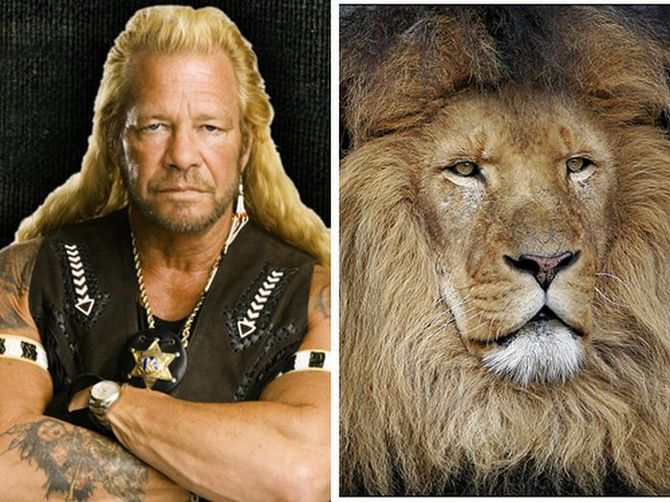
I’m not sure I entirely buy the notion that we humans are so exceptionally tolerant, but I have noticed that you’ve started to look a bit like your dog. In a future post, we may look at whether we may also be evolving to be more like members of the cat family:
Which one is the lion? (source unknown)
_____
Hare, B., & Tomasello, M. (2005). Human-like social skills in dogs? Trends in Cognitive Sciences, 9 (9), 439-444 DOI: 10.1016/j.tics.2005.07.003
We live in an “act now!” world that frequently tests us, luring us with temptations and encouraging us to indulge. We may clearly see the importance of living within our budget yet still be dazzled by the shiny appeal of that new sports car; we may strongly believe in the benefits of a healthy diet yet still be weakened with lust for that large slab of double chocolate cake.
Nevertheless, we do sometimes succeed in delaying immediate gratification for the sake of something better in the future, in remembering those clichés about “good things come to those who wait” that our parents and grandparents inflicted on us. Undoubtedly, this is something we’re able to achieve because we’re humans, because we can be goal-directed and can prevail over our impulses, because we are more than unthinking animals who are captives to their immediate needs. Right?
Not so fast.
It is true that many animals seem unable to defer gratification, with prior experiments showing that animals such as rats, pigeons and chickens will rarely choose a delayed food reward over an immediate one, even if the delayed reward is much more attractive and the delay is only a few seconds. (From an evolutionary standpoint, this sort of impatience may make a lot of sense when an animal faces competition and future opportunities for food are unknown. “Life is uncertain, have dessert first!”)
To date, the major exception has appeared to be in primates: chimpanzees, bonobos, rhesus macaques and capuchin monkeys have demonstrated that they can wait for up to five minutes or so if that enables them to obtain a desirable food reward – a level of performance comparable to that of humans. (Interestingly, tests have shown that we humans seem to be much better at deferring money rewards than food rewards. Perhaps this, too, has a basis in natural selection, as food has been obviously always been an imperative, whereas money has existed for only an evolutionary blink of the eye.)
Also, while all of this might lead one to conclude that the ability to delay gratification lies solely within the province of humans and our closest relatives, it now turns out that corvids, the famously smart bird family (see prior AnimalWise posts here and here and here and here) that includes ravens and crows, may be every bit as patient.
When's dinner going to be ready? (from Wikipedia, photo credit: Cj005257)
As described in a paper published last week in Biology Letters, a team led by Valérie Dufour of the University of Strasbourg recently found that crows (Corvus corone) and ravens (Corvus corax) are able to tolerate delays of over five minutes in order to obtain a better reward, and that they may use the same sort of tactics to distract themselves while they wait as humans do.
In this study, six crows and six ravens were first trained to exchange tokens for food rewards, and then were given a series of “delayed exchange” tests. In each test, a bird would be handed an initial piece of food, which it could either eat immediately or, upon receipt of a signal after a designated waiting period, exchange for a more a desirable reward that it could see throughout the testing period. If the bird ate the initial reward or tried to exchange it too early, the test would end, but if it waited until the proper signal after the waiting period had elapsed – success, a better reward!
The researchers ran the tests with different types of reward (which they labeled as low-, medium- and high-quality) and with varying waiting periods (from 2 to 640 seconds).
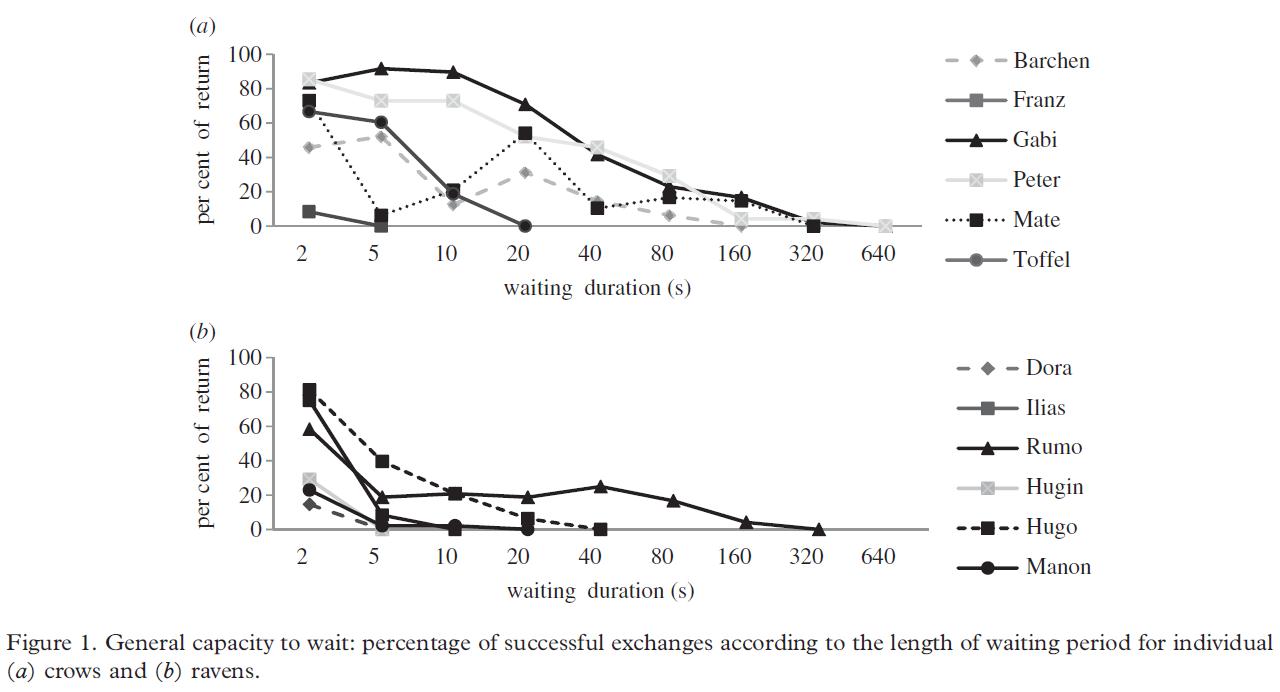
Not surprisingly, the birds were generally more willing to exchange for the most highly preferred rewards and, as the following graphic illustrates, had a harder time as the delay period increased (with both crows and ravens maxing out at 320 seconds, or slightly over five minutes):
Interestingly, when the birds had to wait 20 seconds or longer before being able to exchange, they usually placed the “reward in the hand” on the ground and/or cached it in nearby crevices. The researchers believed this to be a distractive strategy, as “[t]hese behaviours probably alleviate the cost of waiting: not having to hold the food distracts the bird’s attention from it.”
As someone who routinely has to put snack food out of reach or even out of sight in order to prevent Homer Simpson-like devouring, this explanation makes a lot of sense to me. (For those of you who would prefer a more uplifting example of a strategy for avoiding temptation, I invite you to think about Ulysses having himself lashed to his ship’s mast so that he can safely listen to the songs of the Sirens.)
In any event, delaying gratification is significant because it involves, on some level, making a judgment about the future and the likelihood of achieving a prospective reward. While it’s not clear whether this entails a full “sense of self,” it is worth (re)noting that corvids are one of the few animals that have demonstrated the ability to recognize themselves in mirrors, a cognitive test that’s often used to measure whether an animal has at least rudimentary self-awareness.
Once again, corvids are no bird brains!
_____
Dufour V, Wascher CA, Braun A, Miller R, & Bugnyar T (2011). Corvids can decide if a future exchange is worth waiting for. Biology letters PMID: 21920957.
Rosati, A., Stevens, J., Hare, B., & Hauser, M. (2007). The Evolutionary Origins of Human Patience: Temporal Preferences in Chimpanzees, Bonobos, and Human Adults Current Biology, 17 (19), 1663-1668 DOI: 10.1016/j.cub.2007.08.033.
Heilbronner, S., & Platt, M. (2007). Animal Cognition: Time Flies When Chimps Are Having Fun Current Biology, 17 (23) DOI: 10.1016/j.cub.2007.10.012.
I’ve been thinking about grief lately. It can be so overpowering – the dull ache of emptiness, the stabbing pain of loss, and the prism of sadness that transforms the bright colors of everyday life into a harsh and alien landscape. Consumed by grief, we are alone; yet somehow our solitary suffering can end up strengthening the bonds we have with others we know and love.
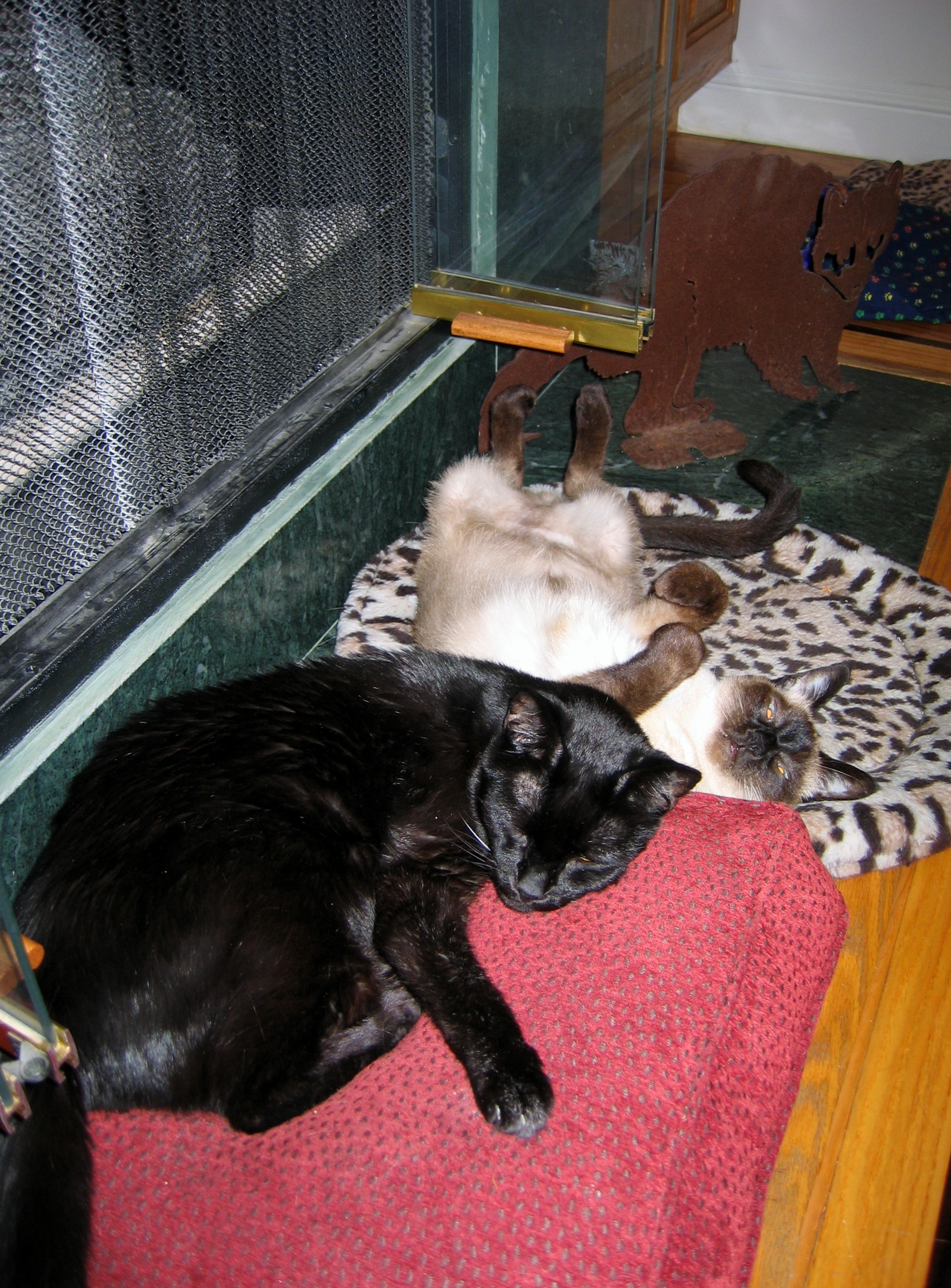
I’ve also been thinking about grief in animals, and what we know about it. When our cat Puggsley died, our younger Siamese, Moose, felt the full impact of the loss. The two had always been close, perhaps tied together by their mutual skepticism over Wednesday, our third cat and official people-pleaser. Moose and Puggsley were constant companions, playmates, napping buddies, and a rather frightening pair of mischief makers. When Puggsley became old and frail, he would curl up stiffly by the fireplace, and Moose would bed down near him. At the very end, Moose was right there, tenderly licking Puggsley as he was overcome by a seizure. And after he was gone, she mourned – she was lost without her friend, and had little appetite or energy for weeks. She never bedded down by the fireplace again. How do I know this was grief? Well, it was obvious; I just know.
Puggsley and Moose
But what do we really know about grief in animals – that is, in a scientific sense? Not particularly much, it turns out.
We are (mostly) beyond the era in which animals were considered thoughtless automatons, incapable of feeling pain and other emotions. Still, there have been relatively few formal studies of how animals experience grief.
In a way, this isn’t so surprising. For one, opportunities to systematically observe grieving behavior in the wild are rare and, if you think about it, it’s difficult to design ethical studies intended to cause social animals to grieve in captive settings. Also, what specifically do you test for and how do you quantify and evaluate an inherently subjective experience like grief? It’s tough enough to evaluate this sort of thing in humans, who can respond to questionnaires and use language to express their emotions….
As a result, most the scientific literature about grief in animals is anecdotal or observational in nature, and in many of these accounts it’s clear that otherwise objective researchers have struggled to come up with scientific ways of reporting what, in the end, are their own reactions, what they just know.
Although the record is sparse everywhere, there have been some recent papers on grief in primates. Brian Switek, who writes the Laelaps blog for Wired Magazine, has written a terrific piece on this research in his “What Death Means to Primates” posting (I strongly encourage you to check out Laelaps; it’s one of the best blogs out there on paleontology, evolution, and the history of science).
As Brian recounts in detail, studies have documented chimpanzee and other primate mothers who have continued to carry dead infants, sometimes for weeks and even to the point of mummification. In one of the studies1, researchers described two chimpanzee mothers (Jire and Vuavua) in Bossou, Guinea, who carried their dead babies (aged 1.2 years old and 2.6 years old, respectively) after they had died in a respiratory epidemic, grooming them regularly, chasing away flies, and carrying them during all travel. The researchers pondered:
An obvious and fascinating question concerns the extent to which Jire and Vuavua “understood” that their offspring were dead. In many ways they treated the corpses as live infants, particularly in the initial phase following death. Nevertheless they may well have been aware that the bodies were inanimate, consequently adopting carrying techniques never normally employed with healthy young (although mothers of handicapped young have also been known to respond appropriately).
In another study2, James Anderson, Alasdair Gillies and Louise Lock reported on the peaceful death of an older chimpanzee, Pansy, who lived in a safari park. They videotaped the reactions of Pansy’s companions and observed a number of behaviors that they found to be comparable to human bereavement. The degree to which the researchers sought out human counterparts to the chimps’ behavior is evident from the following description in their paper:
During Pansy’s final days the others were quiet and attentive to her, and they altered their nesting arrangements (respect, care, anticipatory grief). When Pansy died they appeared to test for signs of life by closely inspecting her mouth and manipulating her limbs (test for pulse or breath). Shortly afterwards, the adult male attacked the dead female, possibly attempting to rouse her (attempted resuscitation); attacks may also have expressed anger or frustration (denial, feelings of anger towards the deceased). The adult daughter remained near the mother’s corpse throughout the night (night-time vigil), while Blossom groomed Chippy for an extraordinary amount of time (consolation, social support). All three chimpanzees changed posture frequently during the night (disturbed sleep). They removed straw from Pansy’s body the next morning (cleaning the body). For weeks post-death, the survivors remained lethargic and quiet, and they ate less than normal (grief, mourning). They avoided sleeping on the deathbed platform for several days (leaving objects or places associated with the deceased untouched).
With this focus, it’s not surprising that they concluded by proposing that “chimpanzees’ awareness of death has been underestimated.”
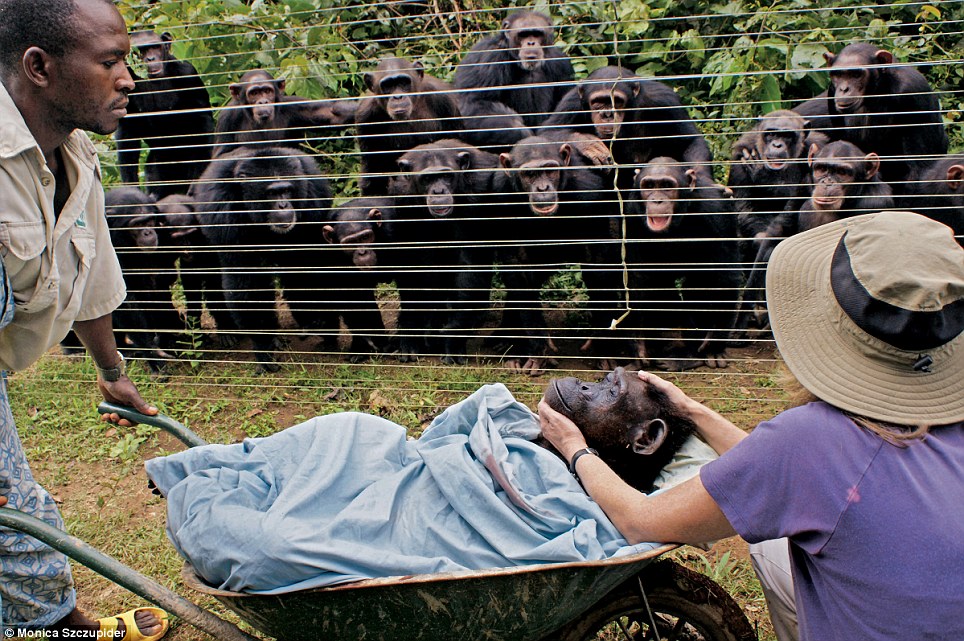
Also, more anecdotally, many were moved by the apparent grief captured in this poignant National Geographic photo of chimpanzees at a rehabilitation center peering at the lifeless body of Dorothy, their long-time companion, being taken to her burial:
There has also been some research into the behavior of elephants towards the dead and dying. In one study3, Iain Douglas-Hamilton, Shivani Bhalla, George Wittemyer and Fritz Vollrath reported on the death of Eleanor, a matriarch elephant in the Samburu National Reserve in Kenya. They were able to use GPS technology to track the movements of elephants in Eleanor’s family and in other families as they reacted to her collapse and subsequent death. The researchers found that Eleanor was visited frequently by both related and unrelated elephants, concluding:
Combined with earlier work and the data of other scientists it leads to the conclusion that elephants have a generalized response to suffering and death of conspecifics and that this is not restricted to kin. It is an example of how elephants and humans may share emotions, such as compassion, and have an awareness and interest about death.
Grace visiting Eleanor's body (photo: Douglas-Hamilton, et al)
In another paper4, Karen McComb, Lucy Baker and Cynthia Moss described experiments in which they assessed elephants’ strong interest in and sometimes dramatic reactions to elephant bones and tusks. After systematically presenting elephants in Amboseli National Park in Kenya with different combinations of elephant and other animal skulls, ivory and pieces of wood, the researchers found that the elephants were significantly more interested in elephant skulls and tusks than they were in the skulls of other animals or in the wood, but that they did not demonstrate a special affinity to the skulls or ivory of deceased relatives. The following video provides a nice glimpse into the way in which elephants seem to be fascinated by elephant bones and tusks:
…
Several reports have also documented cetaceans reacting with apparent grief. In one report5, for example, Mark Simmonds described an incident in which two male orcas appeared to grieve over the death of a female orca thought to be their mother. For years, the two males had spent all their time swimming with this female. After her death, the males were seen swimming together but apart from all other orcas for a day or two, repeatedly visiting the places that their mother had passed in her last few days. In another instance, Robin Baird of the Cascadia Research Collective reported seeing two orcas, a mother and adult son, swimming with a dead calf in the Puget Sound, with the mother balancing the calf on her rostrum or carrying it on top of her head and occasionally lifting it out of the water, and both adults diving deep to recover the baby when it began sinking.
Dolphin and calf (Tethys Research)
Scientists at the Tethys Research Institute related a similar occurrence off the coast of Greece, where a mother bottlenose dolphin was seen interacting with a dead newborn calf. Their description vividly underscores the difficulties in evaluating these sorts of situations from a scientific perspective:
Whilst researchers must avoid being driven by their own feelings and make arbitrary interpretations, in this case it was quite clear that the mother was mourning. She seemed to be unable to accept the death, and was behaving as if there was any hope of rescuing her calf. She lifted the little corpse above the surface, in an apparent late attempt to let the calf breath. She also pushed the calf underwater, perhaps hoping that the baby could dive again. These behaviours were repeated over and over again, and sometimes frantically, during two days of observation.
The mother did never separate from her calf. From the boat, researchers and volunteers could hear heartbreaking cries while she touched her offspring with the rostrum and pectoral fins. Witnessing such desperate behaviour was a shocking experience for those on board the research boat.
Finally, Marc Bekoff (he of the Yellow Snow fame) has written an eloquent article that includes many additional anecdotes regarding animal grief in his Psychology Today column.
Ultimately, there is much we will never be able to understand regarding how animals experience the world. We can trace commonalities between human and other animal brain structures and neural pathways associated with emotional experiences, and we can try to add more systematic observations to our collection of behavioral anecdotes, but in some fundamental ways the animal mind (and, for that matter, the mind of other humans) will always be cloaked in private experience, inaccessible to us. Moreover, as some of the accounts in this post have illustrated, our attempts at understanding animal emotions are inevitably colored by our own human experiences. We can know human grief, but how can we understand what it means to experience chimp grief, or elephant grief, or orca grief?
Nevertheless, just because we cannot fully comprehend what we see in other animals, that does not mean that grief in animals does not exist or that animals cannot lead rich emotional lives. Indeed, what we do see is a pattern that makes it increasing clear that death can impact other animals profoundly.
How do I know this? Just ask Moose, Puggsley or Wednesday – I just know.
_____
1Biro, D., Humle, T., Koops, K., Sousa, C., Hayashi, M., & Matsuzawa, T. (2010). Chimpanzee mothers at Bossou, Guinea carry the mummified remains of their dead infants Current Biology, 20 (8) DOI: 10.1016/j.cub.2010.02.031.
2Anderson, J., Gillies, A., & Lock, L. (2010). Pan thanatology Current Biology, 20 (8) DOI: 10.1016/j.cub.2010.02.010.
3Douglas-Hamilton, I., Bhalla, S., Wittemyer, G., & Vollrath, F. (2006). Behavioural reactions of elephants towards a dying and deceased matriarch Applied Animal Behaviour Science, 100 (1-2), 87-102 DOI: 10.1016/j.applanim.2006.04.014.
4McComb, K., Baker, L., & Moss, C. (2006). African elephants show high levels of interest in the skulls and ivory of their own species Biology Letters, 2 (1), 26-28 DOI: 10.1098/rsbl.2005.0400.
5Simmonds, M. (2006). Into the brains of whales Applied Animal Behaviour Science, 100 (1-2), 103-116 DOI: 10.1016/j.applanim.2006.04.015.
These days, we’ve been hearing quite a bit about a future in which humans find their dominion over the planet suddenly challenged by a group of super intelligent apes. This may make for an exciting Hollywood movie plot and some stunning visual effects, but I wonder whether we really need to look to humanoid science fiction in order to feel a shiver of doubt regarding our supremacy as a species.
Maybe all we need to do is to look at the world the way it is, a world that could well be called … The Planet of the Ants!
So, why is it that we should feel just a wee bit threatened by these small six-legged colonizers? Here are just a few reasons.
Quadrillions of Ants
Burning Man seems more crowded every year, doesn't it? (photo credit: Mehmet Karatay)
Like us, ants thrive just about anywhere, with the exception of Antarctica and a few isolated islands. Moreover, while there are approximately seven billion of us on the planet, conservative estimates put the number of ants at between one and ten quadrillion.1 That’s between 150,000 and 1,500,000 ants for each and every one of us. At the higher figure, this means that, if you were to put all the world’s ants onto a giant scale, they would weigh about as much as all of the humans on the planet put together.2 In fact, on average, it has been estimated that ants make up 15–20% of the terrestrial animal biomass on Earth (and more than 25% of the animal biomass in tropical regions).3
Our tendency as humans is to unquestioningly assume that we are far and away the most successful species that has ever been. If we take a step back, though, and simply consider the above numbers and the possibility that an animal’s success is most properly measured by the degree to which it has been able to thrive in various environments, perhaps we should already be feeling a pang of doubt about how incontestable our supremacy really is.
Ants Teach
While many animals are able to learn through imitation, ants are the only non-mammal known to engage in interactive teaching.4 In at least one species of ant, knowledgeable workers actively teach inexperienced nest mates where to find food through a process known as “tandem running,” in which the lead worker ant recruits an inexpert follower, and then makes sure that the follower stays on track, slowing down when it lags and speeding up when it gets too close.
Ants Learn
Ants are also able to engage in so-called latent learning, whereby they memorize information that they cannot use at once, but that may be useful later on – a behavior that’s been labeled as “planning.”5 Specifically, ants have been shown to be able to reconnoiter potential new living spaces, retaining information about relative desirability and tailoring their choices based on how urgently the need to move is.
Ants Can Learn to Navigate Mazes
Ants can be trained to remember multiple visual patterns presented in a fixed sequence, enabling them to navigate mazes.6 Ok, I’m not sure how exactly this leads to world domination, but it is definitely pretty cool.
Ants Practice Agriculture
Approximately 50 million years ago (and, accordingly, approximately 49+ million years before Homo Sapiens first arose as a species), ants began engaging in agriculture.7 Today, different species of leafcutter ants have adopted a purely agrarian lifestyle, feeding exclusively on gardens of fungus that they actively weed and cultivate, feed with fresh-cut leaves, and keep free from parasites and other pests.8 Here’s a video of some fungus farming ants:
Ants Engage in Animal Husbandry
Some ants raise aphids and feed on the sugary honeydew the aphids secrete when “milked” by the ants’ antennae. The ants are careful with their herds, keeping predators and parasites away, moving the aphids from one feeding location to another, and often bringing the aphids with them when they migrate.9 Here’s a video of ants tending to their aphids:
Ants Sometimes Enslave Other Ants
Certain types of ants are incorrigible slave-makers, raiding other colonies of ants and making captured slaves perform all routine tasks for their masters, including brood care, foraging, and even feeding slave-maker workers who are unable to feed themselves.10 Obviously, this isn’t a particularly attractive ant characteristic, but unfortunately it is one that may seem all too familiar to us humans.
Ants Use Tools
That’s right, tools. For example, some ants transport liquid and other non-solid food by dropping bits of leaves, sand or mud pellets or pieces of wood into a pool of food and, after the food has soaked in, using these objects to carry the meal back to their nests.11 Other ants use pebbles and soil pellets as weapons, dropping them on other ants or ground-dwelling bees, and then attacking and killing their competitors.12
Ants Build Cooperative Solutions
Hey, watch your foot! You're stepping on my head! (photo: Mlot, Tovey & Hu)
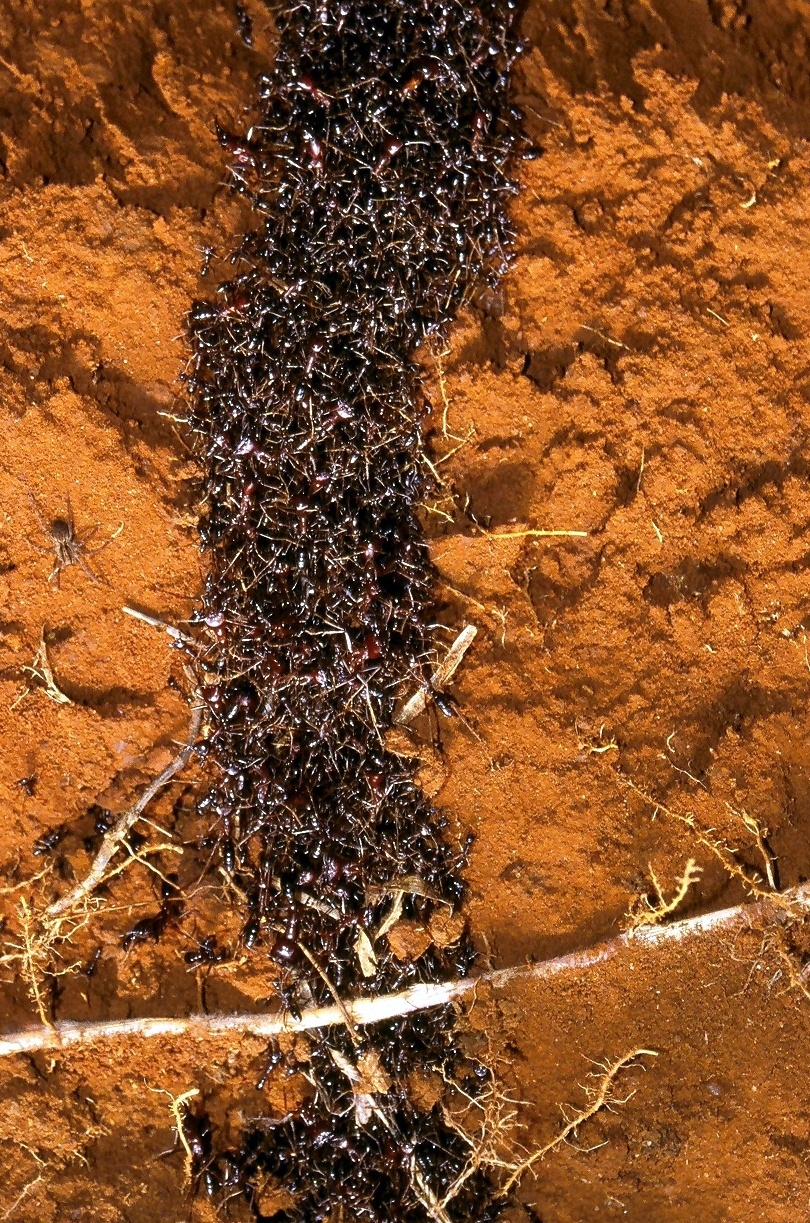
Ants, including army ants, are known to self-assemble into living bridges or ladders that allow them to cross gaps while on the move. When a single ant cannot make it across alone, other ants will successively grab on, steadily lengthening the bridge until it’s long enough to reach the destination. These structures, which can span significant distances and can even cross water, are then used by the rest of the colony and may stay in place for hours, until traffic dies down.13 Comparably, fire ants self-assemble into waterproof rafts to survive floods. These rafts can be made up from anywhere from a few hundred to many thousand ants and are incredibly durable, allowing ants to sail for months at a time as they migrate.
Ants Have “Collective Intelligence”
The concept of collective intelligence has been hot lately, with a number of books and articles describing how groups can make collectively make sophisticated decisions and solve complex problems, even where each individual in the group knows very little, collectively a g (think of the analogy of each individual acting as a neuron, and the group as a whole acting as a collective brain). Collective intelligence is a topic unto itself, one we may address in future posts, but for now suffice it to say that if ants truly can make wise decisions as a group, we humans may really have something to envy!
_____
1Holldobler, B & E. O. Wilson (2009). The Superorganism: The Beauty, Elegance, and Strangeness of Insect Societies. New York: W. W. Norton. p. 5. ISBN 0-393-06704-1.
2Ibid.
3Schultz, T. (2000). In search of ant ancestors Proceedings of the National Academy of Sciences, 97 (26), 14028-14029 DOI: 10.1073/pnas.011513798.
4Franks, N., & Richardson, T. (2006). Teaching in tandem-running ants Nature, 439 (7073), 153-153 DOI: 10.1038/439153a; Richardson, T., Sleeman, P., McNamara, J., Houston, A., & Franks, N. (2007). Teaching with Evaluation in Ants Current Biology, 17 (17), 1520-1526 DOI: 10.1016/j.cub.2007.08.032.
5Franks, N., Hooper, J., Dornhaus, A., Aukett, P., Hayward, A., & Berghoff, S. (2007). Reconnaissance and latent learning in ants Proceedings of the Royal Society B: Biological Sciences, 274 (1617), 1505-1509 DOI: 10.1098/rspb.2007.0138.
6Chameron, S., Schatz, B., Pastergue-Ruiz, I., Beugnon, G., & Collett, T. (1998). The learning of a sequence of visual patterns by the ant Cataglyphis cursor Proceedings of the Royal Society B: Biological Sciences, 265 (1412), 2309-2313 DOI: 10.1098/rspb.1998.0576; Reznikova, Z. 2008: Experimental paradigms for studying cognition and communication in ants (Hymenoptera: Formicidae). Myrmecological News 11: 201-214.
7Schultz, T., & Brady, S. (2008). From the Cover: Major evolutionary transitions in ant agriculture Proceedings of the National Academy of Sciences, 105 (14), 5435-5440 DOI: 10.1073/pnas.0711024105.
8Ibid.; Schultz, T. (1999). Ants, plants and antibiotics. Nature, 398 (6730), 747-748 DOI: 10.1038/19619.
9Nielsen, C., Agrawal, A., & Hajek, A. (2009). Ants defend aphids against lethal disease Biology Letters, 6 (2), 205-208 DOI: 10.1098/rsbl.2009.0743; Styrsky, J., & Eubanks, M. (2007). Ecological consequences of interactions between ants and honeydew-producing insects Proceedings of the Royal Society B: Biological Sciences, 274 (1607), 151-164 DOI: 10.1098/rspb.2006.3701.
10Pohl, S., & Foitzik, S. (2011). Slave-making ants prefer larger, better defended host colonies Animal Behaviour, 81 (1), 61-68 DOI: 10.1016/j.anbehav.2010.09.006; Brandt M, Foitzik S, Fischer-Blass B, & Heinze J (2005). The coevolutionary dynamics of obligate ant social parasite systems–between prudence and antagonism. Biological reviews of the Cambridge Philosophical Society, 80 (2), 251-267 PMID: 15921051; Hölldobler, B. & Wilson, E.O., 1990. The Ants, Harvard University Press.
11FELLERS, J., & FELLERS, G. (1976). Tool Use in a Social Insect and Its Implications for Competitive Interactions Science, 192 (4234), 70-72 DOI: 10.1126/science.192.4234.70.
12See, e.g., Pierce, J. (1986). A Review of Tool Use in Insects The Florida Entomologist, 69 (1) DOI: 10.2307/3494748.
13Mlot NJ, Tovey CA, & Hu DL (2011). Fire ants self-assemble into waterproof rafts to survive floods. Proceedings of the National Academy of Sciences of the United States of America, 108 (19), 7669-73 PMID: 21518911.
Recognizing someone you know is actually not a simple cognitive task – it requires you interpret the information you’re currently receiving through your senses, and then link back to a previously-formed conceptual representation you have of the individual in question. It’s especially difficult if you are acting cross-modally, for example matching someone’s voice to a photograph or vice versa.
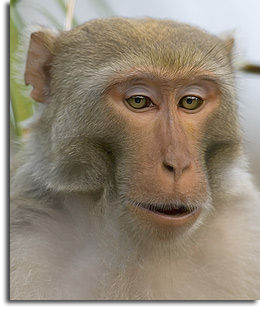
Oh yeah, I remember him. He's the one with the high squeaky voice, isn't he? (photo credit: Joe Kegley)
Recently, two separate studies have shown that rhesus macaque monkeys (Macaca mulatta) are quite up to this challenge, reflecting that they possess a considerable degree of social memory and engage in complex conceptual thinking about other individuals.
French Pictures
In the first study1, published earlier this year in Proceedings of the National Academy of Sciences, a French research team headed by Julian Sliwa of the University of Lyon confirmed that rhesus macaques are able to spontaneously match the faces of known macaques and humans to their voices.
In their experiments, the research team gave six macaques a large number of tests in which they played short voice samples of known individuals (coos and grunts for other macaques, short French sentences and phrases for humans) and then measured how long the macaques spontaneously looked at cropped photographs of two known faces, only one of which matched the voice they had heard. The researchers statistically analyzed whether the macaques spent more time looking at specific photos after hearing the matching voice than they did after hearing a different voice, and found that the macaques did indeed stare significantly longer at a photo – whether of another macaque or a human – if the matching voice had been played first.
In reviewing individual performance, the researchers observed that five of six of the macaques displayed this effect overall, and that a greater number were better at recognizing photos that matched human voices than ones matching the voices of fellow macaques (the researchers noted that they were surprised at this finding, but pointed out that perhaps the explanation was that there were more useful auditory cues in the human speech samples than there were in the monkey coo vocalizations). Finally, the researchers found that five of the six monkeys showed preferences for specific faces, spending an especially long time looking at matching” photos of certain individuals – often a “neighbor” monkey or the researcher who was their main caregiver.
The researchers concluded that rhesus macaques can recognize individuals, linking together abbreviated visual and auditory perceptual cues (small, two-dimensional photos and short sound samples) to spontaneously identify other macaques and socially-relevant humans, and even to reflect the preference biases they have towards specific individuals.
At the Movies
The second study2, published last week in PLOS ONE, extended the findings to show that rhesus macaques can also recognize photos of other macaques whom they had seen during video clips, an additional challenge because specific features can be harder to identify in dynamic movies than in still images.
In this study, researchers led by Ikuma Adachi of the Yerkes National Primate Research Center began by training five macaques to watch brief silent video clips of familiar individuals before identifying which of five randomly placed photos represented the individual in the video. At first the macaques were allowed to continue to look at the last frame of the video before having to choose the correct photo, but in a second phase of the experiment the screen went black after the video was played, and the monkeys had to choose the correct photo after a time lag.
In each case the macaques became proficient at the task, even performing well after seeing videos taken from a novel perspective that was substantially different than the view in the training videos. Thus, their performance suggested that they were able to recognize specific features of known individuals as they appeared in dynamically-changing scenes in a range of videos, and then extract that information to identify those individuals later on in still images.
Next, the researchers repeated the testing, but this time they tweaked the conditions by playing a brief vocalization right after showing the last frame of the some of the videos – either a vocalization of the macaque in the video (the “congruent condition”) or of a different macaque (the “incongruent condition”). Only two of the macaques participated in this testing, as apparently the other three weren’t comfortable with working in the sound isolation booth necessary for this phase.
The researchers found that the macaques, who had never been trained to use vocalizations to guide their test responses, continued to be good at choosing the “correct” photo, but that when they made errors, they were statistically more likely than chance to pick the image of the vocalizing monkey, rather than the one in the video.
In other words, hearing the vocalizations systematically biased the macaques’ choice behavior, indicating that the voices may have activated visual representations of the vocalizing monkeys that occasionally superseded the impact of what had been seen in the video. Again, the macaques were demonstrating how they processed the information they used to recognize information cross-modally.
…
So, clearly “see no evil” is linked to “hear no evil” – perhaps we’ll see how “speak no evil” fits into the picture in a later post.
_____
1Sliwa J, Duhamel JR, Pascalis O, & Wirth S (2011). Spontaneous voice-face identity matching by rhesus monkeys for familiar conspecifics and humans. Proceedings of the National Academy of Sciences of the United States of America, 108 (4), 1735-40 PMID: 21220340.
2Adachi, I., & Hampton, R. (2011). Rhesus Monkeys See Who They Hear: Spontaneous Cross-Modal Memory for Familiar Conspecifics PLoS ONE, 6 (8) DOI: 10.1371/journal.pone.0023345.
 Bernardi, G. (2011). The use of tools by wrasses (Labridae) Coral Reefs DOI: 10.1007/s00338-011-0823-6






 paulfnorris
 AnimalWise